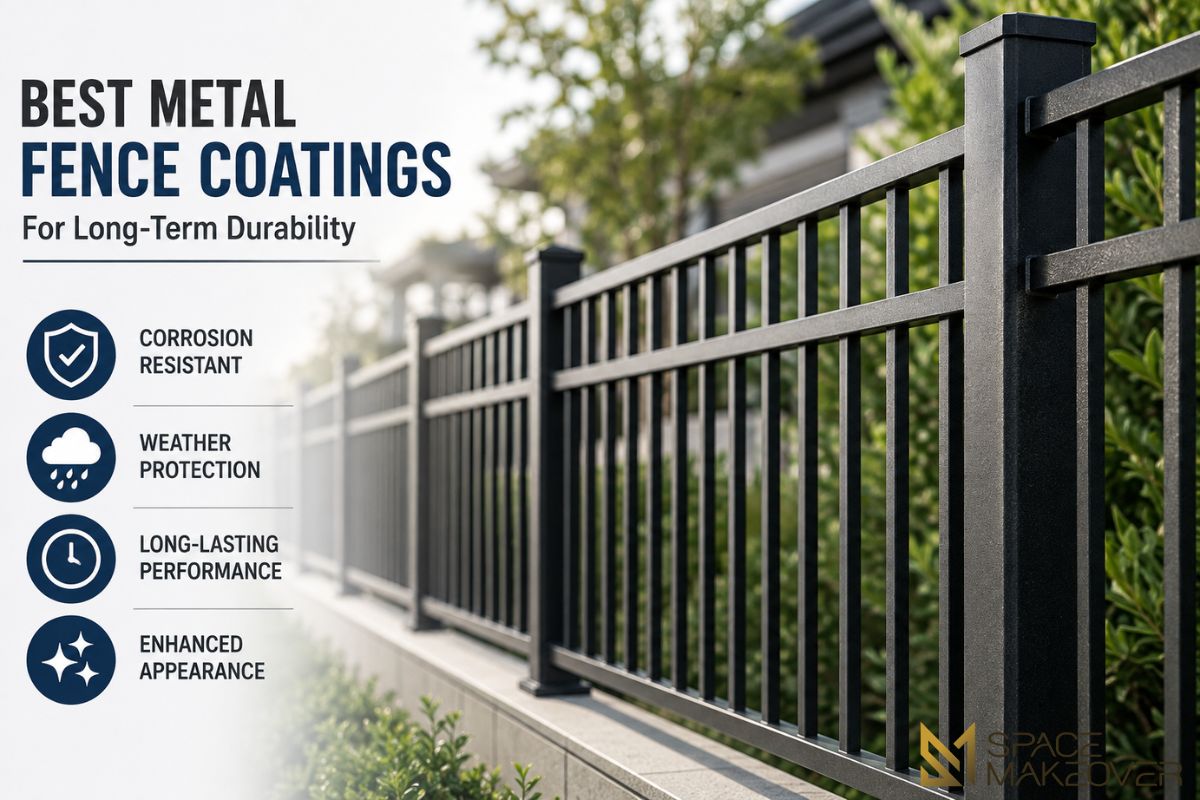
Best Metal Fence Coatings for Long-Term Durability
In terms of the climate of Dubai, a duplex coating system is suitable for metal fences. This system uses hot-dip galvanizing followed by polyester or PVDF powder coating. This type of coating will be effective against heat, moisture, and rust. According to exposure conditions, hot-dip galvanizing will greatly increase the lifespan of steel fences for about 20–50 years. While it does provide effective protection on its own, adding powder coating allows the steel to withstand the humidity, salt air, and UV radiation of the Gulf much better than either paint or single coating.
Most of the experienced suppliers of metal fencing in Dubai currently use this technique for their boundary walls, fencing for villas, and industrial fencing because single-layer coating becomes practically useless after five to eight years in a coastal environment. What really counts is how many meters away the fence is from the sea or industry and whether you can afford it.
Key takeaways
- Hot-dip galvanizing offers a longer duration of corrosion protection than bare steel.
- Duplex systems combine powder coating and galvanizing to ensure better defense against the elements.
- The level of humidity, salt in the air, and UV rays in Dubai make the coating deteriorate faster.
- Reputable fencing dealers suggested that coating thickness is checked beforehand.
Why does coating choice decide how long your fence lasts?
Steel does not fail because it is too weak. It fails as moisture and oxygen reach the surface and initiate an electrochemical reaction. This is where coatings come in to prevent that reaction, either by restricting moisture in some manner or by corroding themselves first.
This is more significant than it is in many markets. Dubai and Ajman are coastal cities, so fencing has to deal with the seawater in the air, months of high humidity, and strong UV radiation that is more aggressive than in temperate regions. A coating that lasts for thirty years in Europe may last much less in this place if it is not the right type and if the layer is too thin to begin with.
Therefore, coating specifications become just as important as steel grade. A fence with a structurally strong design would rust if it is improperly coated.
Hot-dip galvanizing: The industry benchmark
The process of hot-dip galvanization provides protection to steel by having it submerged in molten zinc. After the zinc process, a solid heat-resistant layer is present over the entire area of the steel, including hidden sections. The layer of zinc on the surface also protects the steel when there is any scratch to the heated metal. Thus, zinc reacts slowly instead of the exposed steel and stops it from getting rusted.
According to ISO 1461, the thickness of the layer is normally between 55 and 85 microns, depending on the thickness of the steel. This protection can last between fifty years and ninety years or more in dry places with less pollution. In marine and industrial settings, which is closer to what Dubai and Ajman actually deal with, realistic lifespans drop to around 20 to 30 years for galvanizing on its own.
That gap is exactly why galvanizing rarely stands alone on visible fencing here. Think of it as the foundation, not the finish.
What to check: ask your fabricator for the coating thickness in microns, not just whether it’s “galvanized.” Coatings applied thin to cut costs fail years before the standard would suggest.
Powder coating: finish, colour, and trade-offs
Powder coating involves a dry pigment that is electrostatically applied and then cured under heat to produce a film that can be made even and smooth. This practice is what makes most of the decorative and residential metal fences in the UAE come in standard RAL colors such as black, bronze, or anthracite, and not the dull gray that comes with raw galvanization.
Powder coating is purely a barrier on its own and does not have any sacrificial protection. This means that it is ineffective in protecting the exposed steel underneath once it chips or scratches. Salt spray testing under ASTM B117 proves that well-formulated powder coatings can prevent blistering and corrosion for about 500 to 1000 hours under accelerated laboratory conditions. This time frame is enough to get a rough estimate of the lifetime exposure close to the sea, but it is worth noting that it is not a straight time-to-time conversion.
Additionally, the practical takeaway with metal fencing services in Dubai is that powder-coated covering over untreated or insufficiently prepared steel looks nice at first for a year or two, before failing in those areas where the coating is naturally thinner, namely at the weld joints and edges. The method of powder coating over hot-dip galvanized steel, the duplex technique, addresses this issue. Even if the powder coating chips, the underlying zinc is still effective.
PVDF and fluoropolymer coatings for harsh climates
PVDF (polyvinylidene fluoride) coatings sit a step above standard polyester powder coating. It’s the same fluoropolymer chemistry used on high-end architectural cladding, and it holds colour and gloss far longer under UV exposure. Standard polyester powder coats tend to chalk and fade within a few years under Gulf sun; PVDF is formulated specifically to resist that.
The catch is cost. PVDF runs noticeably more than standard powder coating, and it’s usually reserved for architectural feature fencing, commercial frontages, or projects where colour consistency over 15-plus years genuinely matters. Not really the call for a standard boundary wall.
For most residential and light commercial jobs, polyester powder coating over galvanized steel already covers what you need. PVDF earns its price on facades and signature installations, where the appearance is part of the brand itself.
Coating comparison table
| Coating Type | Typical Lifespan (UAE Coastal Conditions) |
Best For | Key Limitation |
|---|---|---|---|
| Hot-Dip Galvanizing (Alone) | 20–30 years | Structural, industrial, hidden fencing | Dull grey finish, no colour options |
| Standard Powder Coating (Bare Steel) | 3–8 years | Budget, indoor, low-exposure fencing | No protection once scratched |
| Duplex: Galvanizing + Powder Coating | 25–40+ years | Villas, boundary walls, commercial perimeter | Higher upfront cost |
| PVDF / Fluoropolymer over Galvanized Steel | 30+ years, best colour retention | Architectural facades, feature fencing | Premium pricing |
| Zinc-Rich Primer + Liquid Paint | 8–15 years | Repairs, retrofits, smaller budgets | Needs repainting cycles |
Why is Dubai and Ajman’s climate tougher on metal?
Three things stack up here that rarely all show up together in one climate: airborne salt from the coast, high humidity for months on end, and UV intensity noticeably stronger than in temperate regions. Throw in construction dust and, in some areas, industrial pollutants, and you get faster versions of the exact corrosion mechanisms that lab tests like ASTM B117 are built to simulate.
That’s a big reason fencing suppliers in Ajman working near the industrial belt or the coastline tend to steer clients toward duplex coatings, even when budget pressure is pushing the other way. The upfront cost difference is small next to the cost of re-fencing a property in year six instead of year twenty-five.
Common mistakes that shorten coating life
- Skipping surface preparation- Rust, mill scale, or leftover oil on the steel means the finish never bonds properly, no matter how good the coating itself is.
- Choosing colour before corrosion resistance- Aesthetics matter, but picking based on shade alone often means the thickness spec never gets a second look.
- Under-specifying thickness to save cost- A coating that’s technically “galvanized” but falls under the ISO 1461 minimum corrodes years ahead of schedule.
- Ignoring welds and cut edges- These are always the weak points in any coating system, and the first place rust actually shows up.
- Treating one coating as right for the whole property- A fence facing the sea needs a different spec than one tucked against a shaded inland wall.
Expert insights from the field
Fabricators who’ve worked across several UAE emirates will tell you the failures they see most often aren’t material failures. They’re spec failures. A client asks for “galvanized fencing” and never confirms the micron thickness. A contractor swaps in standard powder coating on a coastal villa to shave a bit off the quote. The fence looks fine the first year. By year three, rust is bleeding through at the welds.
Therefore, the properties that hold up over a decade or more tend to share the same pattern: proper surface prep, coating thickness matched to the actual exposure level, and a supplier who’ll explain the trade-offs instead of just handing over a price. Space Makeover approaches fencing projects the same way, matching the coating system to a site’s real exposure rather than defaulting to whatever’s cheapest to keep in stock.
How to choose the right coating?
Start with location. A fence within a few hundred metres of the coast needs stronger protection than one set further inland. From there, think about how much colour and finish consistency actually matters to you. If it’s a boundary wall nobody’s looking at closely, standard duplex coating usually does the job. If it’s a visible commercial frontage, PVDF might be worth paying for. Last thing: get the coating thickness stated in writing, not just the coating type. “Galvanized” and “properly galvanized to spec” aren’t the same promise.
Conclusion
There’s no single best coating for every metal fence. There’s a best coating for your specific exposure, budget, and how long you actually want it to last before it needs attention again. For most properties across Dubai and the wider UAE coast, a duplex system of hot-dip galvanizing under polyester or PVDF powder coating gives you the strongest balance of durability and cost. If you’re comparing quotes from metal fencing suppliers in Dubai, ask specifically about coating thickness and whether it’s single-layer or duplex before you compare prices. That one question tells you more about long-term value than the finish colour ever will.
Frequently asked questions
Usually 20 to 30 years in coastal or industrial areas if there’s no topcoat, longer further inland. Duplex coating extends that quite a bit.
Not really, near the coast, on bare steel. Expect 3 to 8 years before corrosion shows up at welds and edges.
PVDF is more resistant to UV loss of colour and UV loss of gloss but more expensive. For fencing that isn’t exposed to much, standard powder coating is the less expensive choice.
At that location, the coating is burned off, and the area is left exposed to corrosion unless it is re-coated there, or the entire piece re-galvanized following welding.
Most of the established suppliers do, particularly on coastal properties, due to its high initial expense and much greater maintenance-free period.
Often, yes, as long as the underlying steel is still structurally sound. Another 10 years could be added with surface prep and a new system of duplex or powder.
Request confirmation (in accordance with ISO 1461), which is normally in the range of 55 to 85 microns, depending on the thickness of steel, and which is usually not included in a quote- it is assumed.
Not fundamentally. The coating science remains the same, but in some areas of Ajman, close to industrial areas, suppliers may be tempted to increase the duplex specification.
Depends on the scale of the project, and although the premium will normally be relatively small, it is usually quite a bit less than re-fencing a property years in advance of when you would want to.
Colour is not the primary durability factor, though darker colours will absorb more heat and will fade faster in UV. The most important thing is the coating type and thickness.