Motorized Entrance Door Installation in Dubai: Step-by-Step Process
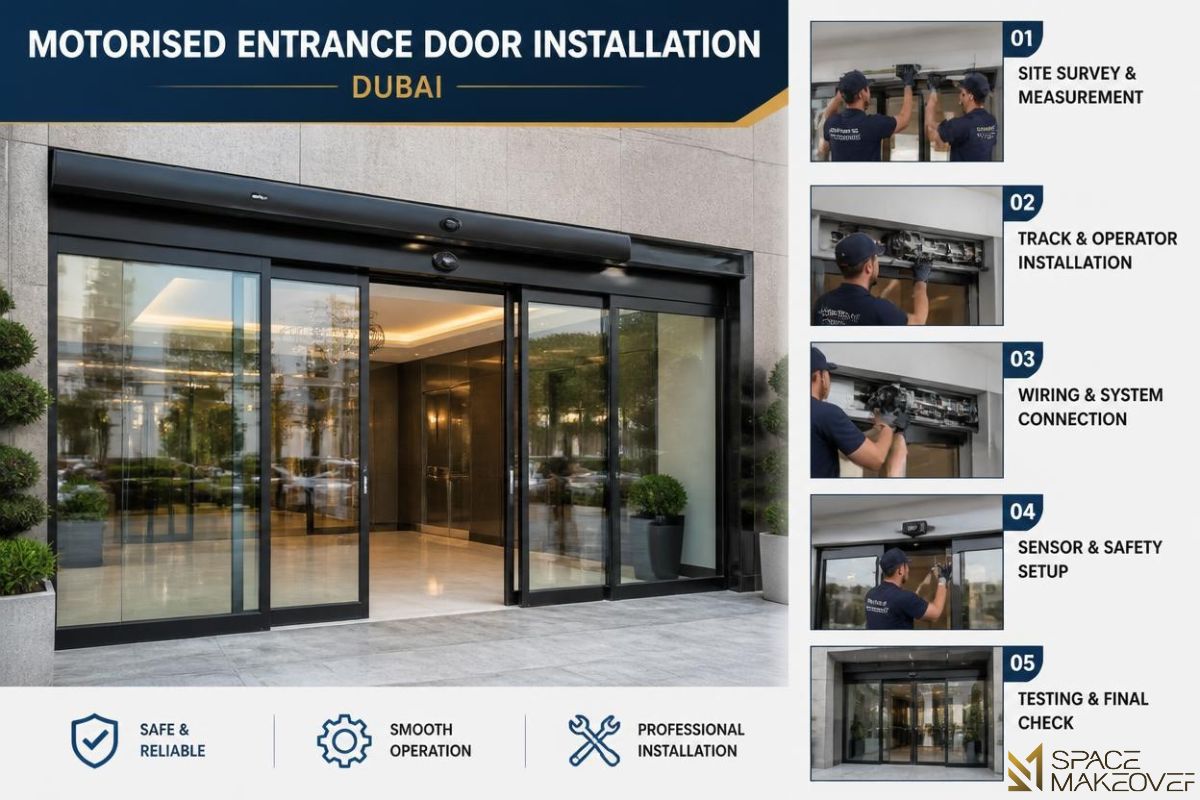
The motorized entrance door installation in Dubai involves six basic processes: the site survey, preparation of the frame, fitting of the track and the motor, calibration of the sensor, installation of the access wiring, and finally the actual testing. A single slide entrance will take one day, but a larger commercial access with key cards and biometrics will take longer, with the usual expectation of three days. The biggest factor that determines how long everything will take is whether the entrance should be modified or not before running the project.
The above is just a summary of what happens. The following will showcase the actual sequence of events on the site and all mistakes that people sometimes make when they hurry through this process.
Key takeaways
- Usually, a motorized entrance door in Dubai requires between one and three installation days.
- Dubai weather conditions make a big difference when it comes to selecting motors, seals, and other elements.
- A slim sliding door in Dubai provides an effective solution for restricted space in confined lobbies.
- Besides door hardware, issues such as sensor location and door access coordination should also be considered.
What does a motorized entrance door actually involve?
A motorized door isn’t a manual door with a motor tacked on afterward. The frame, track, sensor placement, and power routing get planned together from day one, not fitted around each other later.
Most setups across Dubai fall into a handful of types:
- Automatic sliding entrance doors, single or telescopic
- Swing doors driven by a motor arm
- Revolving doors for lobbies with heavy footfall
- Folding or bi-parting glass doors for wider openings
However, in narrow corridors or tight retail frontages, a slim sliding door in Dubai is usually the more sensible pick. It skips the wall clearance a swing door needs, which matters a lot in older buildings that were never designed with automation in mind.
Site survey and measurement stage
This isn’t a five-minute job with a tape measure, whatever it might look like from the outside. A proper survey checks:
- Header height, and whether it can actually carry the motor unit
- Floor levelness, since even a small slope throws off a sliding track
- Power availability near the frame, or the need for a new wiring run
- Wind load, particularly if the entrance faces an exposed side or sits near a high-rise
Dubai’s heat plays into this more than most people realize. Aluminium frames expand slightly in peak summer, so installers leave a small tolerance gap that wouldn’t even occur to a manual-door fitter. Skip it, and the door starts binding or dragging within a few months.
Choosing the right door type and frame
This is where the client’s brief runs into the building’s actual constraints. A retail unit on Sheikh Zayed Road doesn’t need the same setup as a villa entrance in Arabian Ranches.
| Option | Best suited for | Notes |
| Aluminium frame, single glazed | Interior lobbies, low sun exposure | Lighter, cheaper, less thermal resistance |
| Aluminium frame, double glazed | Ground-floor commercial fronts | Better heat and noise insulation |
| Frameless glass panel | Showrooms, boutique retail | Higher cost, needs precise motor calibration |
| Aluminium and steel hybrid | High-traffic commercial entrances | Heavier duty, longer service life |
Firms handling aluminium doors and windows services in Dubai usually push double glazing for anything facing west or south. Afternoon sun on a single-glazed panel adds up over a year in cooling costs. It’s a minor spec change that pays for itself.
Furthermore, if the glass panel itself is the centerpiece, sorting a glass door supplier in Dubai early on saves headaches later. Custom-cut tempered or laminated glass tends to have a longer lead time than the motor hardware, so ordering it upfront keeps the schedule from stalling.
Track, motor, and sensor fitting
Once the frame is confirmed level, the mechanical work starts.
For sliding systems, the top track goes up first and gets checked for level across its full run before the motor is fixed at one end. Rollers attach to the door panel and get hung on the track, adjusted until the panel moves without catching anywhere. A bottom guide keeps it from swaying side to side while it’s in motion.
Swing doors work differently. The arm connects the frame to the door leaf, and someone needs to check the swing radius against nearby walls or foot traffic before the motor gets powered on.
Sensors come next:
- Motion sensors above the header, angled to catch approach without tripping on people walking past outside
- Safety beams at floor level, to stop the door if someone’s still in the way
- Push-plate or wave sensors for accessibility, common in retail and healthcare entrances
Therefore, badly angled sensors are one of the most common callback issues installers see. Set too wide, they trigger on anyone walking past on the street. Set too narrow, they miss someone approaching from an angle.
Wiring, access control, and testing
This is where the motor connects to its control board, and where relevant, to an access system.
A basic motorized entrance door in Dubai with no access restrictions needs fairly simple wiring: power to the motor, a link to the sensors, and a manual override in case of a power cut. Commercial buildings usually layer on more:
- Card or fob readers
- Intercom-linked release
- Biometric access for restricted areas
- Integration with the fire alarm, so doors unlock automatically during an emergency
Moreover, testing comes last, and it shouldn’t get skipped even when the schedule is tight. A proper run covers open and close speed, hold-open timing, sensor sensitivity, manual override, and what happens during a simulated power cut. Space Makeover usually does this with the client present, so if hold-open timing or sensor range needs a tweak, it happens on the spot instead of as a follow-up visit.
Cost factors to expect in Dubai
Pricing swings a fair bit depending on door type, glazing, and how much access control is involved. What tends to move the number:
- Door width and weight, since heavier panels need stronger motors
- Single versus double glazing
- Frameless glass versus framed aluminium
- Number and type of sensors
- Access control integration
- Whether the opening needs structural work first
A basic single-slide unit for a home entrance sits at the lower end. A wide commercial frontage with frameless glass, biometric access, and fire-system integration lands much higher. Getting someone out for a site visit and a written quote is worth it. Remote estimates based on photos alone tend to miss structural issues that only show up once someone’s actually inspected the opening.
Maintenance after installation
Automated doesn’t mean maintenance-free. Dust is the main problem in this climate, especially for track-based sliding systems.
A few habits that keep a system running well past year one:
- Wipe down and lubricate tracks every few months
- Check sensor lenses for dust, which cuts down detection range
- Test the manual override monthly so it doesn’t seize from disuse
- Get the motor’s belt tension checked annually, since heat cycling loosens it over time
Therefore, buildings that skip this end up calling for repairs on parts that would’ve lasted years longer with basic upkeep.
Common mistakes to avoid
A few issues keep showing up across installations:
- Picking a motor rated for the door’s static weight but not its dynamic load during wind gusts
- Skipping the thermal expansion gap, which causes binding in summer
- Installing sensors without accounting for foot traffic outside the building
- Treating access control as an afterthought instead of routing wiring during the frame stage
Most of this traces back to rushing the survey. A door can look identical to a properly installed one on day one and behave completely differently six months later if the groundwork got skipped. A glass door supplier in Dubai can give you the right advice.
Final word
Getting a motorized entrance door in Dubai right comes down to the parts nobody sees afterward: an accurate survey, glazing that suits the building’s sun exposure, and sensors placed with real foot traffic in mind instead of a rough guess. Space Makeover handles this from measurement through to final testing, working across aluminium framing, sliding and swing systems, and glass panels for both retail fronts and residential entrances around Dubai.
If you’re weighing up a new entrance or replacing an old manual door, a site visit is still the most reliable way to get an accurate scope and quote before anything starts.
Frequently asked questions
A single-slide residential unit usually takes a day. Commercial entrances with access control and multiple sensors can run two to three days depending on wiring.
Often, yes, provided the frame and opening are structurally sound. The door leaf, track, and hinges may need replacing to handle the extra motor load safely.
Most systems include a manual override or battery backup, letting the door open by hand or hold its position until power comes back.
Yes, it’s a common pick for tight storefronts since it skips the swing clearance a hinged door needs on either side.
Rarely, unless the door gets repositioned or the layout around it changes. The lenses just need regular cleaning.
Usually, yes. Frameless panels need thicker tempered glass and tighter motor calibration to make up for the missing frame support.
Yes, that’s standard on most commercial jobs, so doors unlock automatically if the fire alarm goes off.
Heat expands aluminium and can affect motor performance if the unit isn’t rated for high ambient temperatures. Dust on tracks and sensors is the other recurring issue