Common Problems with Motorized Entrance Doors and How to Avoid Them
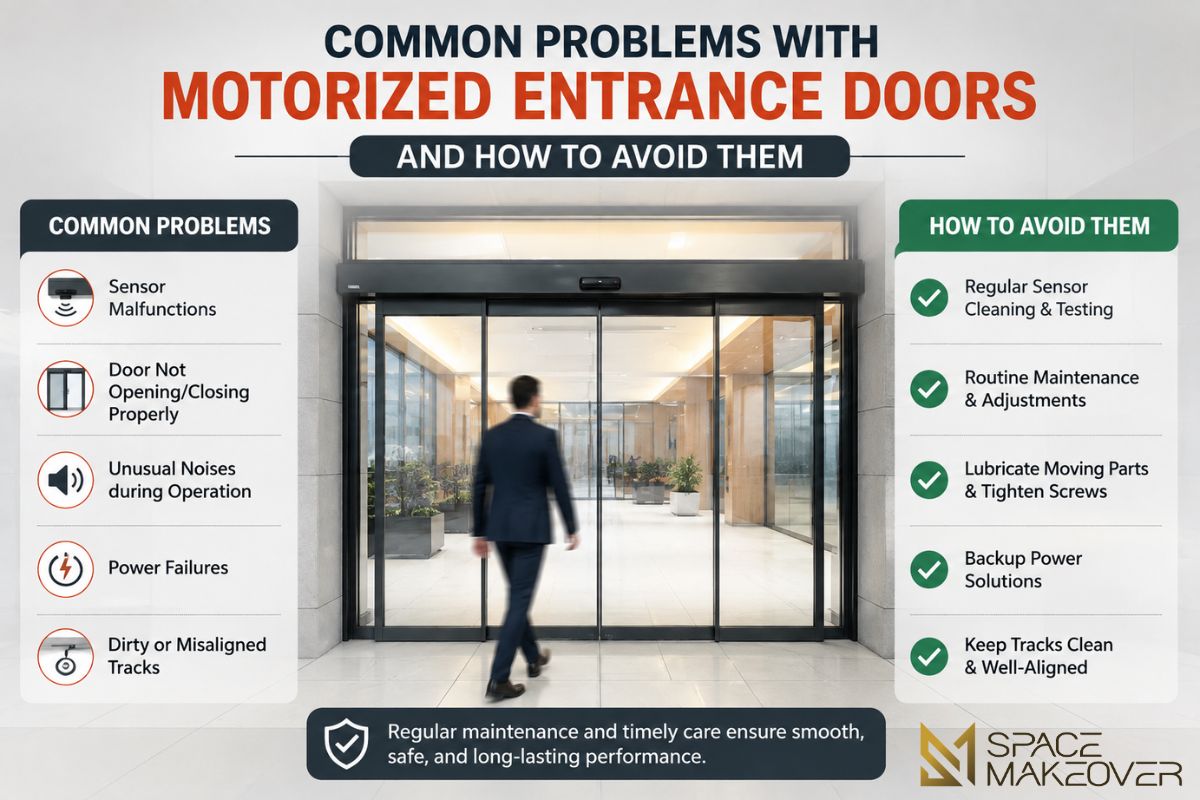
Motorized door failures can be attributed to four main reasons, which are improperly functioning sensors, worn-down tracks that are worn down, installation on the wrong type of frame, and lack of maintenance. The local climate of Dubai negatively affects the impact of all these factors. With a lot of dust in the air, sensors would go out of calibration faster. Tracks would be worn down because of constant temperature fluctuations. There are alignment issues with a door installed without taking into account either the weight of the glass or the building’s settlement.
- Faulty sensors represent the highest percentage of failures reported in commercial buildings.
- Failures due to wear of tracks and rollers are the second most mentioned issue, especially in door openings of frequently used entrances.
- Inadequate installation becomes evident when patterns of recurrent problems are observed rather than one-off cases of a malfunction.
- A properly maintained door, for instance, which is serviced twice a year, does not require emergency repairs.
There are no extraordinary measures needed for this; just choose the right system for the building, introduce it properly, and stick to a regular maintenance schedule.
Key takeaways
- Sensor misalignment leads to greater failures of motorized doors compared to issues related to the motor.
- The high temperatures and dust of Dubai harm the longevity of inferior quality components.
- The slim sliding doors should have frames and track specifications designed for durability.
- With their experience, motorized sliding door suppliers can prevent some of the design-related issues in advance.
Why do motorized entrance doors break down?
People believe that motorized doors should function infinitely. This is a misconception. A motorized door is machinery; thus, it contains mechanisms that will break over time depending on its surroundings. Think of a hospital door that runs 4000 cycles a day and a fashion boutique door that waits for 200 clients.
The extreme heat in the UAE causes most of the problems. Most motors meant for regular commercial use will be challenged when operating under the heat and air conditioning pressure differences, especially if it is 45 degrees outdoors. Add dust from the desert, and the equipment will wear out quicker than expected.
The motorized sliding door business in the Middle Eastern region has been worth 1.28 billion dollars and is driven by demand in Dubai and Abu Dhabi among both commercial businesses and high-end residential buildings. Such growth brings more dealers, but it does not guarantee the quality of products from the suppliers. Many sellers offer equipment numbers without knowing how to choose a motor and prepare it for 42-degree heat.
Sensor problems that cause false triggers
Sensors are usually the first part of a motorized entrance door in Dubai to fail, and it rarely happens all at once. A door that used to open cleanly starts hesitating, or triggers for people walking past on the sidewalk instead of people actually approaching it.
Three things cause most of this:
- Dust on the sensor lens- Even a thin film changes the detection range.
- Misalignment after cleaning or glass work-Someone knocks the header during a window clean, and nobody recalibrates afterward.
- Sun glare– common on west-facing entrances in the afternoon- throws off motion sensors that aren’t shielded for it.
None of that needs a new sensor. It needs someone to check the existing one, which is where most buildings fall short. The check doesn’t happen until the door stops working entirely, and by then it’s an emergency callout instead of a five-minute fix.
However, worth knowing: infrared and microwave sensors don’t behave the same way in dust. Microwave reads through a light film better, which is part of why some UAE suppliers now default to dual-sensor setups on busy doors rather than relying on one detection type.
Motor and track wear nobody notices until it’s too late
The motor takes the blame for most door failures. In practice, the track is usually the actual problem.
Rollers running on a dirty or slightly warped track load the motor unevenly, so it works harder to compensate. Do that for months, and the extra strain shortens the motor’s life. By the time the door actually stops, you’re often replacing two components instead of cleaning one track.
Signs the track is behind it, not the motor:
- A grinding or scraping sound before full failure
- The door opening unevenly, faster on one side than the other
- Noticeably louder operation than a year ago
Dubai’s climate makes this worse than people expect. Aluminum track expands and contracts more than most realize across a heat cycle, and if the original install didn’t leave room for that movement, the track binds slightly every summer. That binding wears the rollers down regardless of how good the motor is.
Installation mistakes that cause long-term issues
Most recurring problems trace back to how the door went in, not the product itself. A few patterns keep showing up:
- Wrong frame for the door type- Slim sliding and slim glass systems carry glass load differently than standard framed doors do. Put a slim glass door in Dubai on a frame built for a heavier commercial unit, or the reverse, and you get stress points that surface as sagging or misalignment within the first year rather than immediately.
- Ignoring building movement- New buildings settle. A door installed rigidly in the first months after handover, with no allowance for that settling, often needs realignment within six to twelve months. That’s a planning gap, not a defective product.
- Skipping load calculations for glass weight- A heavier glass panel needs a motor and track rated for it. Fit a standard-panel motor to an oversized or upgraded panel, and it’ll burn out faster, sometimes within a year or two.
- No commissioning test under real daylight conditions- A door tested at 9am, before the sun hits the entrance, can pass fine and still glare-fault every afternoon. Proper commissioning runs the door through a full day, not one snapshot of it.
Design problems with slim sliding systems
Slim profile systems have caught on in Dubai for a reason. They look cleaner, let in more light, and fit the minimal aesthetic a lot of commercial and residential projects are going for now. But “slim” means less material carrying the load, and that changes the engineering margin.
What a slim sliding door in ajman actually needs:
| Consideration | Standard Sliding Door | Slim Sliding Door |
| Frame material thickness | Higher tolerance for stress | Requires precision-rated frame |
| Glass load distribution | Spread across wider frame | Concentrated, needs reinforced track |
| Motor sizing | Standard commercial motor | Often upgraded or calibrated motor |
| Heat expansion tolerance | Moderate | Tighter margins, more critical |
| Ideal application | High-traffic commercial | Boutique retail, residential, offices |
The trouble starts when a supplier fits standard hardware to a slim system because it’s cheaper or more familiar. The door runs fine for a while, then the problems show up. If a slim glass door in Dubai is priced close to a standard door, that’s usually where the corners were cut.
Choosing the right motorized sliding doors suppliers
This is the stage where most of the above gets prevented, or built in from day one. A door is only as good as whoever specs and installs it.
What actually matters when picking automatic sliding doors suppliers in Dubai:
- Do they ask about footfall and usage before quoting? A mall entrance and a private office door shouldn’t get the same spec.
- Do they factor climate into the motor and sensor choice? Not every product line is rated to hold up under sustained UAE heat.
- Can they point to completed projects with similar door types? Slim systems, standard commercial doors, and heavy-duty entrances aren’t interchangeable skill sets.
- Do they offer an actual maintenance plan, or just an installation and a goodbye?
- Are they certified to relevant standards, such as EN 16005, which covers power-operated pedestrian doorsets and their safety-in-use requirements? That certification isn’t paperwork for the file. It changes how the door behaves around an obstruction.
Therefore, Space Makeover runs every project through this same process: traffic patterns, glass load, and climate exposure assessed before a system gets recommended, rather than fitting a generic motor to whatever frame a client had in mind.
Maintenance that actually prevents failure
Reactive maintenance, waiting until the door fails to do anything about it, costs more than scheduled maintenance every time. A basic servicing routine catches sensor drift, track wear, and loose fixings before any of it turns into a shutdown.
A proper maintenance visit should cover:
- Sensor cleaning and recalibration
- Track inspection for debris, wear, and alignment
- Roller and bearing lubrication
- Motor performance check under load
- Safety edge and obstruction detection test
- Weather seal inspection, especially before summer
Moreover, twice a year covers most commercial entrances. High-traffic sites like hospitals, malls, and airports usually need it quarterly. More than half of newly installed motorized door units worldwide are now sliding, sensor-based mechanisms, which means the servicing skill set needed is getting more specific, not less. A general contractor isn’t automatically equipped to handle that.
Final thoughts
Motorized entrance doors don’t fail at random. A sensor didn’t get cleaned, a track wasn’t rated for the climate, or a slim system went in with the wrong hardware. Every one of those is preventable with the right supplier and a maintenance schedule that actually gets followed instead of filed away.
If you’re planning a new entrance, or dealing with a door that keeps acting up, get it assessed before the next failure turns into a full replacement. Space Makeover can walk through what’s actually causing the issue and what a properly specced system looks like for your building.
Frequently asked questions
Usually the sensor sensitivity is set too wide, or there’s glare interference on a west-facing entrance. Recalibrating the angle and range typically fixes it without new hardware.
Twice a year for standard commercial use, quarterly for high-traffic sites like malls or hospitals. Heat and dust shorten the interval compared to milder climates.
Yes, if it’s specified for it. A slim system built for boutique or office use will wear faster in a high-traffic commercial entrance without upgraded hardware.
8 to 12 years with proper installation and regular servicing. Without maintenance, motor and sensor issues can show up within 2 to 3 years.
Yes. It sets the safety requirements for power-operated pedestrian doors, including obstruction detection. A non-compliant door is a real safety risk in high-footfall settings.
The aluminum track expands with heat. Without enough tolerance built into the original install, the track binds slightly during hot months, which causes the noise and uneven movement.
If the frame and glass are still sound but the motor or sensors are failing, retrofitting is usually the cheaper route. Full replacement makes sense once the frame itself is undersized for current use.
Thinner frame profiles mean less margin for load distribution. They need precision hardware and careful glass load calculation that standard systems can skip.
Yes. Opening only when needed and closing promptly cuts cooling-related energy loss by a meaningful margin compared to doors left open manually.
One that asks about footfall, climate exposure, and glass load before quoting is doing it right. A quote with no site details attached is worth a second look.