What’s the Difference Between Tempered and Regular Glass for Showers?
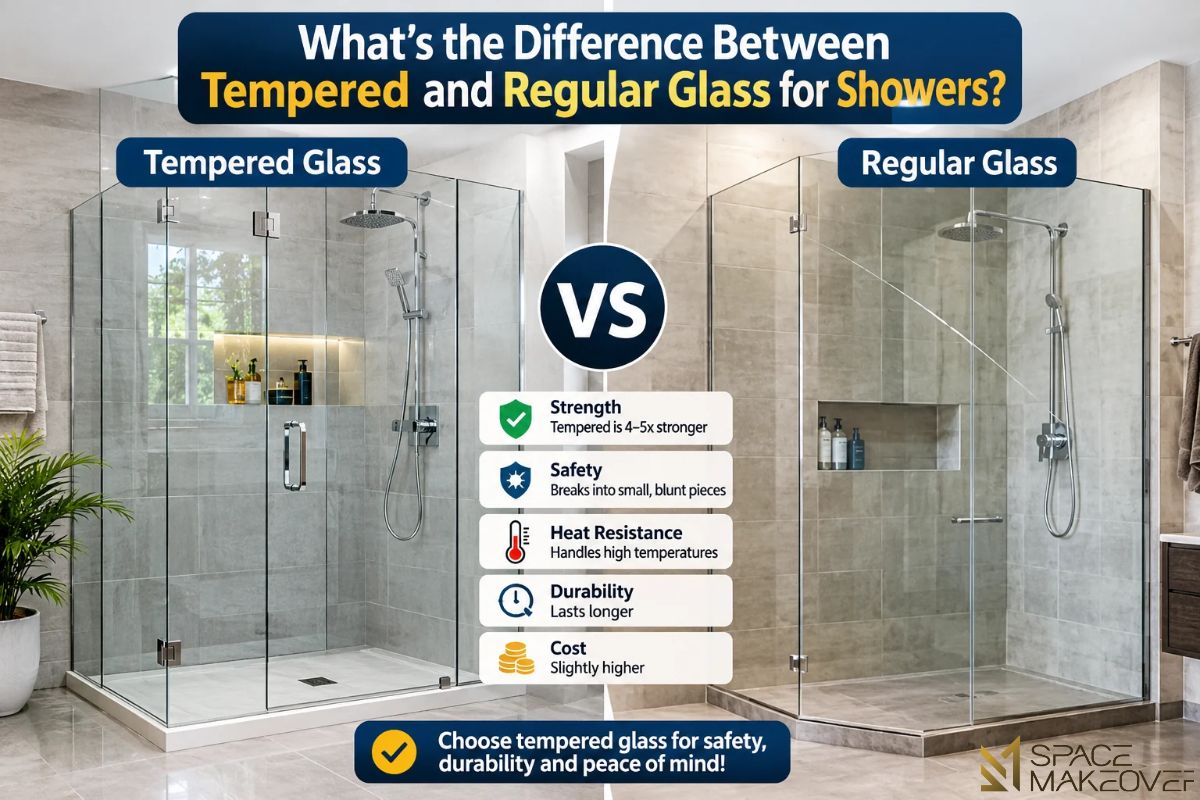
Tempered glass is a better and stronger option for showers. Regular glass, which is known as float glass or annealed glass, is much cheaper but shatters into large jagged pieces, which pose a risk of injury. Tempered glass goes through heat treatment to become several times stronger than regular glass, and breaks into small blunt pieces instead of sharp ones. For wet areas like bathrooms, tempered glass should always be used. If you are going to get a shower partition in Dubai, then it is better to know the differences between the glass types so that you can choose a safe type suitable for the local climate.
At Space Makeover, we have received this question from many homeowners and property developers. In this guide, we will explain what the various types of glass look like, how each of them performs on a daily basis, and what to know before placing an order.
Key takeaways
- Tempered glass is a lot more resilient than regular glass of identical thickness; thus, it is a more effective solution for wet areas.
- When shattered, tempered glass will break into small blunt pieces and no sharp edges will appear, unlike traditional glass.
- Regular glass is inexpensive and simple to modify but often not suitable for use in shower areas.
- Proper thickness and quality of hardware, as well as proper sealing and professional fitting of the units, matter more than anything else when it comes to long-lasting use.
What is tempered glass?
Tempered glass is regular float glass that is reheated and then cooled quickly under controlled conditions. The result of this process is that the outer surfaces are compressed while the inner surfaces are stretched. This balance makes the glass strong and gives it its characteristic behaviour when it breaks. In some markets, it is also referred to as toughened glass, but the product is the same.
The manufacturing process is important because the internal stress is the source of the strength of tempered glass. All cuts, holes, and edges should be completed before the heat treatment process.
How is tempered glass manufactured?
Tempered glass is made in a specific order, with each process influencing the final product. Responsible fabricators adhere to this process precisely; otherwise, the panel would be unusable or unsafe to use.
- Cut glass to the proper size and polish or grind the edges.
- Drill holes and make all cutouts, since these cannot be added after tempering.
- Heat the glass in a furnace to roughly 620 to 700 degrees Celsius.
- Cool both faces quickly using high-pressure air jets.
- Inspect the finished panel for flatness, surface quality, and stress distribution.
The sequence is the reason why it is necessary to have accurate measurements when you are using tempered glass. Even a few millimetres of misalignment cannot be fixed, and the panel has to be replaced. Time and money are saved if hardware positions are planned in advance before the order is placed.
Why does tempered glass break differently?
If a stress in the system is applied that exceeds its limits, the energy stored in the glass is released all at once. The shards are tiny and not as long or sharp as they used to be. That’s why tempered glass is so popular in car side and rear windows, doors, and balustrades where impact could be an issue.
Keep in mind that tempered glass isn’t impenetrable. It is possible to break it under extreme impact, and the small pieces may cut. The major benefit is that injuries are typically less serious than those resulting from traditional glass.
What is regular glass?
The fundamental flat glass made by floating molten glass on a pool of molten tin is called regular glass, typically referred to as annealed or float glass. It is then slowly cooled, meaning that there is no internal stress to which the glass is subjected, as in tempered glass. This slow cooling also allows for easy cutting, drilling, and making modifications to regular glass after it is manufactured.
Those are the reasons why regular glass is so prevalent. It is used in windows, mirrors, picture frames, display cabinets and other interior partitions where safety glazing rules do not apply. It is also less expensive by the square metre, making it an attractive option for large projects, typically with low budgets.
Moreover, there are some real benefits to regular glass. They can be set up on site by the installer, can be readily obtained for unusual sizes, and are easier and cheaper to replace. Its resistance is, however, low, and its breakage releases long, sharp pieces. In a bathroom environment, the surfaces are wet, hard, and close to human bodies, which creates a significant hazard.
Tempered vs regular glass: key differences
After installation, tempered and regular glass look almost the same. These are the areas in which their true distinctions manifest themselves. Here is a summary in tabular form of the similarities and differences.
| Feature | Tempered Glass | Regular (Annealed) Glass |
| Strength | Several times stronger at the same thickness | Standard strength |
| Breakage pattern | Small, blunt pieces | Large, sharp shards |
| Heat resistance | High, handles temperature shifts well | Lower, more prone to thermal cracking |
| Cutting after production | Not possible | Possible |
| Typical use in showers | Widely recommended | Generally not recommended |
| Relative cost | Higher | Lower |
| Safety glazing | Commonly accepted for wet areas | Limited suitability for wet areas |
Strength and Impact Resistance
Tempered glass is much more impact- and bending resistant than ordinary glass of similar thickness. In order for cracks to propagate through the panel, the external compression layer must be broken. This applies in a shower, where the glass won’t crack from the weight of the shampoo bottle, bags, or even a slip of the person’s hand against the glass.
Stress is focused at the edges, corners and fixing points, so strength is essential at these locations. A panel that is well made and has been tempered, with edges polished and holes positioned properly, will do much better in these areas than an annealed panel of the same size.
Breakage Behaviour
The greatest safety difference is that of breakage. Regular glass fractures along a line and can tear off long strands that hang on to the frame or hinges. These fragments can cut deep, especially if a person is wet and grasping for help.
Tempered glass, on the other hand, shatters into small shards. Pieces are less apt to cause deep lacerations, and the area is more easily cleared. However, protective gloves and footwear should be worn by all who come in contact with broken glass, and the area should be thoroughly cleaned.
Thermal Performance
Sudden changes in temperature are experienced in the bathrooms. When hot water comes into contact with cold glass, there’s a lot of steam that can quickly accumulate, and direct sunlight can cause some parts of a panel to be warmer than others. This is because the tempered glass is more resistant to such thermal stresses than normal glass.
Thermal cracking is more likely to occur in regular glass, particularly when the glass has very small edge imperfections, or when it is heated unevenly. Tempered glass is a much more predictable material over time, especially in a shower enclosure where temperature changes occur daily.
Cost and Availability
Standard glass is more readily available and less expensive than the special glass. Tempered glass is more expensive due to the furnace processing costs, as well as the need to plan all modifications. Measurement mistakes can cost dearly when orders are placed, so it is crucial to measure accurately before production starts.
There can also be variations in lead times. Fabrics for tempered orders can take longer, as the fabricators are required to finish, drill, and heat treat each panel. When planning your bathroom renovation timeline early on, you don’t have to worry about delays affecting other parts of the project.
Why is tempered glass the preferred choice for showers?
Tempered glass is the best option for shower partitions, as recommended by most professional installers. There is pragmatic as well as regulatory motivation:
- It is much stronger, and thus resistant to all day-to-day pressures in a busy bathroom.
- This shatters into small, blunt fragments, minimizing the risk of injury to users and family members.
- It will stand up better to hot and cold extremes than standard glass.
- When installed and sealed correctly, it has good performance in humid conditions.
- It works with frameless hardware such as hinges, clamps, and wall profiles for toughened panels.
Building codes all over the world require that glass used for shower enclosures and doors adjacent to bathing areas should meet strict safety glazing requirements. Tempered glass is the most commonly used material that fulfills the requirement. The specifications can vary depending on the location and the project, thus have them checked out with your contractor or local authorities before you make an order.
Apart from fulfilling the requirements, tempered glass provides you with a sense of security. Usually, homeowners pay no attention to their shower doors until something bad happens. Opting to use a strong and safe option right from the beginning helps avoid replacement, injury, and insurance issues later on.
When might regular glass be used?
Most people don’t want to use regular glass for a shower enclosure. It might still be used in areas where there’s no requirement for safety glazing, and impact is unlikely to occur. Examples include decorative mirror backing, shelves that are not near water, picture frames, and interior partitions in dry rooms.
Regular glass is seen to be suitable for budget projects where the glass will never come in contact with any shower spray or water. In the latter situations, the saving can be justified. But bathroom plans may evolve, and a dry panel can find itself inundated with water when the bathroom is remodeled.
Consider whether the cost savings of using regular glass is worth the danger of injury, the possibility of thermal cracking, and the risk of not gaining approval for installation in any wet area. The slight price difference just isn’t worth it in most cases.
However, it is not possible to find a reliable glass that can handle the load and safety requirements of a frameless shower enclosure in Dubai without tempered glass. As with any design, if it is near water and humans, tempered glass is the sensible specification, despite how easy it may seem.
How thick should shower glass be in Dubai?
The thickness of the glass will influence the strength, weight, hardware needed, and the appearance of the enclosure. The standard sizes of shower glass are 6mm, 8mm, 10mm and 12mm; the thinner the glass, the lighter the shower panel and the cheaper; the thicker the glass, the more solid the shower panel and the more suitable for large openings.
Appearance is never a good way to determine thickness. The thickness of the glass should match the hardware, and a lot of hinges, clamps, and channels are designed for a limited thickness range. Please have your thickness checked with your fittings by your installer before starting up the fabrication process.
Choosing a Thickness for Your Bathroom
- 8 mm: Commonly used for smaller shower screens, some sliding doors, and for smaller designs where weight is a factor.
- 10 mm: Common size for medium-sized panels and frameless enclosures, providing a balance of strength and affordability.
- 12 mm: Best for wide or tall panels and to give a more premium and solid look in bigger bathrooms.
Moreover, thickness is not the only factor; width and height of panels are significant too. A thick glass will be needed for a tall narrow panel to prevent flexing; a medium thickness may well be sufficient for a short wide panel. A professional site survey can be used to determine an appropriate balance.
Dubai climate considerations
The heat, humidity, and salt air from the sea in Dubai pose certain challenges to bathroom glass. Nearby windows and the surrounding environment may cause thermal stress due to strong sunlight, and humidity or salt may cause corrosion of the metal hardware and seals. The region also has a problem with hard water, which causes mineral deposits to form when the glass is not cleaned on a regular basis.
Installing with high-quality stainless or marine hardware and proper silicone sealing will help the installation withstand the effects of these conditions. An experienced glass works in Dubai provider will also ensure that glass is cut, tempered, and fitted with local considerations.
Where does a frameless design fit in?
Bathrooms have become more popular with frameless designs, as it opens up the room and creates a more spacious feel. They let more light in, offer a clean, modern appearance, and diminish the amount of visible metal profiles. Typically, the most commonly used glass for most frameless systems is 10mm or 12mm tempered glass that has a minimal number of clamps, hinges, and wall channels.
Due to the amount of load it has to bear, the glass must be completely tempered and fitted exactly. Professional measurement and installation are quite important, as it can cause uneven stress on the panel if there is a misalignment.
Common benefits of frameless designs include:
- A continuous line of sight that creates the effect of an open space bathroom.
- Less metal tracks and frames to catch dirt, soap, and limescale.
- Improved lighting, particularly in bathrooms that have few windows.
- A stylish finish to complement most modern Dubai interiors.
Framed designs are glass designs that are held up by aluminium frames, and are typically thinner designs. They can work out to be budget-friendly and are more flexible with some layouts. The difference is that in most cases, framed doors also employ tempered glass, making the difference not the glass’s safety but the structure itself.
A good glass shower enclosure in Dubai will either be a framed or frameless layout and have professionally finished edges and sealed joints. You can search the Space Makeover website for aluminium and glass bathroom solutions throughout Dubai.
How do you care for shower glass?
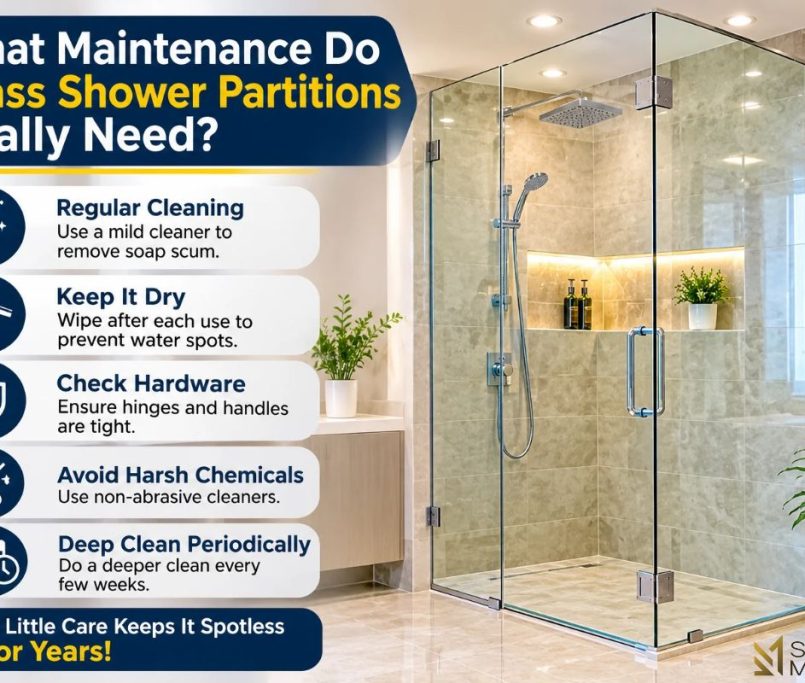
Tempered glass is low maintenance, but if it’s cleaned regularly, it will remain clear, and the seals and hardware will not be damaged. Regular care also enables you to identify any issues at an early stage, before they become a costly repair.
Follow these steps for a simple, effective routine:
- Use a soft microfibre cloth to clean the glass after showering to avoid water spots.
- Clean with a non-abrasive, pH-neutral glass cleaner or mild soap solution once a week.
- Before it dries, use a squeegee to remove hard water residue from the panel.
- Look for gaps, mould or discoloration in silicone seals every few months.
- Check that hinges and clamps are tight and glass is in place.
What should you avoid?
Certain cleaning products may ruin the glass coating, seals and metal finishes. Do not use abrasive pads, steel wool, sharp acids, and strong cleaners containing bleach. These can cause scratches and lower the surface grade or degrade silicone over time.
Don’t try to drill, cut, or grind tempered glass at home. Any changes to the panel release the internal stress, causing the panel to break unexpectedly. When changing is necessary, please contact the original fabricator or a qualified installer.
What mistakes should you avoid when buying shower glass?
Most of the issues that arise with shower glass are due to the unnecessary choices that were made when ordering. Before finalizing a quote, here are some common mistakes to avoid:
- Measure before ordering the final opening: Not all walls of Dubai buildings are square, so it is better to check this on-site.
- Choosing thickness without checking hardware: Fittings made for glass measuring 8 mm may not be compatible with panels that are 12 mm thick.
- Skipping the safety marking check: Each tempered panel must carry a visible mark indicating that it has been tempered.
- Forgetting the drainage and sealing plan: If sealing is poor there can be leaking behind the panel and damaging of walls.
- Choosing the cheapest quote without comparing specifications: The low price may indicate the use of thinner glass, poor quality, or quick service.
Comparing quotes from different suppliers will undoubtedly reveal those discrepancies. A proper quote is expected to disclose information about the glass type, thickness, edge finish, hardware, and amount of installation needed.
How do you choose the right shower glass?
When designing your shower partition in Dubai, use this checklist to ensure you are making the right choice and avoid unnecessary costs down the line:
- Ensure that the glass is fully tempered and request to see the safety symbol for each panel.
- Measure the opening correctly, taking into account wall tolerances, floor levels, and fixtures’ positions.
- Select the thickness according to the size, weight, and type of hardware.
- Opt for the desired edge finishing technique, such as polished or pencil edge, and choose whether you want clear or tinted glass.
- Make sure to check if the installer checks the sealing, drainage, and leveling before installation takes place.
- Request a written quote that includes the type and thickness of glass, furniture, and installation process.
An experienced supplier displays samples to clarify all options and provide answers to questions prior to commencing any cutting operations. If the responses are uncertain, then one should consider obtaining an alternative quotation. The Space Makeover company can assist with tailored recommendations according to bathroom design and budget.
Wrapping up
For showers, tempered glass delivers the ideal combination of safety, performance, and strength, while regular glass is far more appropriate for use in dry decorative applications. While planning your bathroom, be sure to use fully tempered glass of the appropriate thickness, with quality components to be installed by a skilled contractor.
A beautifully designed glass shower enclosure in Dubai can significantly change the look of your bathroom for the better. If you would like to learn more about how to achieve this, contact Space Makeover.
Frequently asked questions
Yes. Tempered glass is more durable than ordinary glass as it shatters into smaller blunt fragments which are safe to handle in wet environments.
Yes, it breaks easily when hit hard, but crumbles into smaller fragments which are less likely to cause severe harm.
Not suitable to use on wet surfaces because it is prone to breaking into sharp pieces when handled by humans and has poor thermal conductivity properties.
Tempered glass is used for most showers between 8mm and 12mm thickness according to size, design and hardware requirements.