
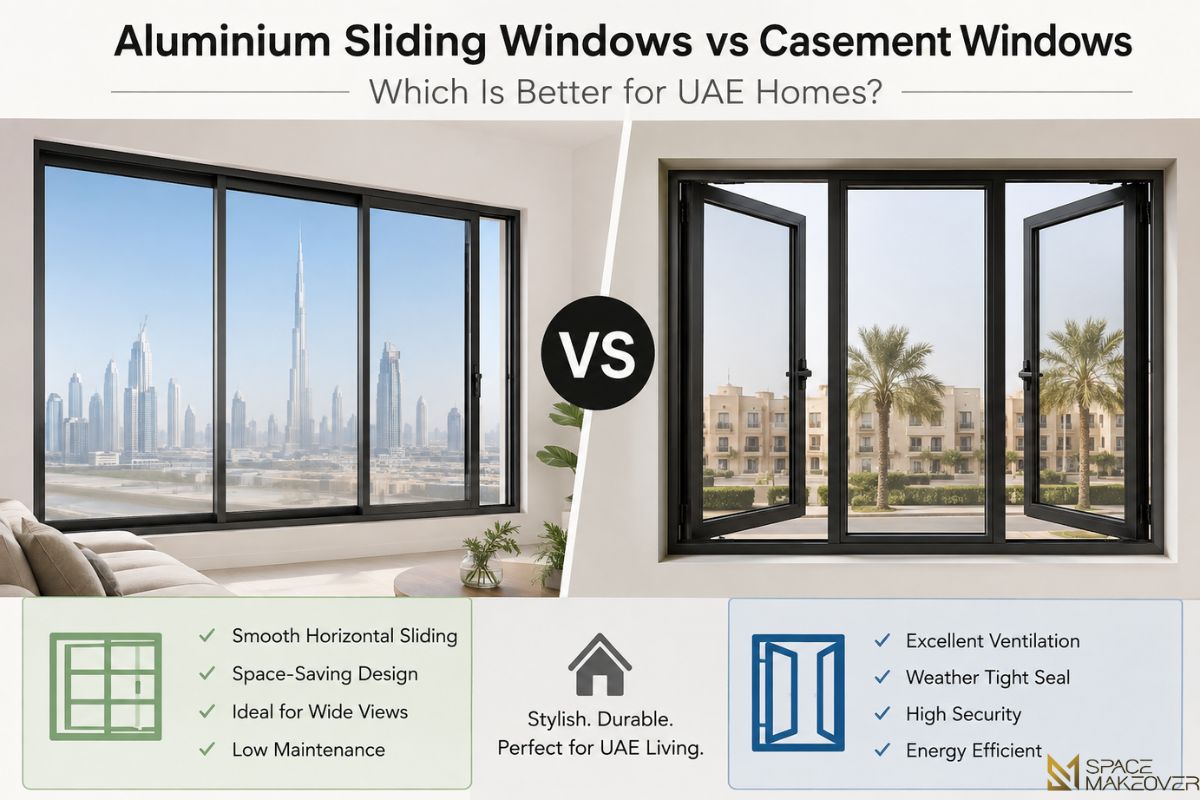
Aluminium Sliding Windows vs Casement Windows: Which Is Better for UAE Homes?
When comparing the different types of windows for UAE homes, aluminium sliding windows in Dubai seem to be the most advantageous. The limited number of moving parts makes it less likely for them to jam during a sandstorm; installation is more affordable than that of casement windows (by 15 – 20 %), as one does not have to worry about swing clearance required for a balcony or in tight layouts.
Therefore, casement windows also have their merits, as they squeeze more air inside when fully opened. In other words, if a buyer wants to pay a little bit more money for an option of having fresh air inside the bedroom or on the wall facing the current winds, then casement windows are a good option. The average temperature during summer in Dubai is above 41° C with minimal UV exposure, making the choice of frame much more important than in moderate climates.
Key takeaways
- Horizontal tracks manage sand better than hinges; sliding windows are the appropriate choice for the climate in the area.
- Due to the tighter seal, casement windows are a better option if dust or noise are a problem.
- Sliding windows tend to be cheaper per square meter and do not intrude on the clearance of the walls.
- The right choice will depend on the orientation of the room, your budget, and the amount of ventilation needed.
How do sliding windows perform in UAE weather?
Sliding windows operate on a horizontal framework, which is what makes them so suitable for this environment. There are no hinges that get stuck when heat expands the metal or swinging windows that can be caught by a strong gust. Dust and dirt accumulate in the horizontal framework instead of obstructing it; therefore, the need for maintenance becomes less frequent.
When it comes to airtightness, sliding windows don’t do as well as hinged windows. Unlike the hinged sash, which presses into its frame, the sliding sash positions itself next to its frame, which allows more air (and dirt) to get through. The good hardware solves that issue to a certain extent; however, there is still some air and dust coming in. It is something to bear in mind if your apartment is located on Sheikh Zayed Road or along another busy street.
Another advantage of sliding windows in Dubai is the fact that there is no need for a swing. Unlike a casement window, which needs to swing out and which can hit furniture, it just slides along the track on the balcony.
How do casement windows perform in UAE weather?
Casement windows are mounted on hinges that result in them opening up much like a door. When closed, the sash is pushed against a rubber gasket placed on the whole perimeter of the frame. That has led to casement windows being tested as better than sliding windows in most cases when speaking about the same size and thickness of the glass.
The presence of a better seal is relevant for the UAE in two respects. First of all, it keeps the cooled air inside during hot months and, secondly, reduces the dust from entering from neighboring construction sites and unpaved roads. Moreover, casement windows open totally, thus ensuring much more airflow than the partially opened sliding ones.
However, there is a mechanical factor rather than the construction one that affects casement windows. The fact is that all the components being exposed to the sun’s rays and temperature fluctuations undergo expansion/contraction and, as a result, lose their position.
Sliding vs casement: side-by-side comparison
| Factor | Sliding Windows | Casement Windows |
| Air-tightness | Moderate | High |
| Dust resistance in tracks/seals | Better (fewer moving parts) | Requires more seal maintenance |
| Ventilation when fully open | Up to 50% of window area | Up to 90-100% of window area |
| Space needed to operate | None (glides on track) | Swing clearance required |
| Typical cost (per sq. meter, UAE) | Lower | 15-20% higher |
| Best suited for | Balconies, large glazing, budget renovations | Bedrooms, wind-facing rooms, noise-sensitive areas |
| Maintenance frequency | Lower | Moderate |
Cost differences you should know
The hardware is responsible for the cost difference, not the glass. Casement windows require locks with multiple points of locking, heavy-duty hinges, and improved gaskets. These elements require a lot of materials and installation costs.
When installed in a typical opening size of 1.2m x 1.2m, sliding windows are usually 15-20% cheaper in Dubai compared to casement windows. However, the total price may vary based on the profile brand and type of glass used.
If budget is driving the decision, it’s worth asking about slim sliding windows Ajman suppliers stock. Slim-profile aluminum offers weight and cost benefits without sacrificing performance. For larger openings, the floor-to-ceiling glass possibilities in a majlis, for example, lead to the use of sliding mechanisms that exclude expensive heavy-duty hinge systems, thus maintaining a cost advantage while increasing the size of the project.
Maintenance and long-term durability
Aluminium won’t rust, but the hardware wears regardless. Sliding tracks collect dust and need cleaning and lubrication now and then. Skip that for a year in a dusty area, and the slide starts sticking. Casement hinges need the occasional tightening too, since the frame keeps expanding and contracting through Dubai’s temperature swings, which can move 20°C or more between a winter night and a summer afternoon.
However, powder-coated aluminium from a reliable aluminium and glass works in Dubai generally holds its finish for 10-15 years before it needs recoating, assuming fairly normal coastal humidity. Anodized frames tend to resist UV fading longer than powder coating, at a higher price up front.
One thing to watch for: cheap gaskets are the first part to fail, no matter which window style you pick. If a supplier has cut corners somewhere, the rubber seal is usually where it shows, often within two or three years.
Which option suits which room?
- Living rooms and balconies: sliding makes sense here. No swing clearance eaten up, and big glass panels suit an open-plan layout
- Bedrooms: casement is usually the better call for a tighter seal and quieter nights, especially on lower floors near traffic
- Kitchens: casement over a sink or counter sidesteps the swing-space problem, since it can be mounted higher up
- Home offices or study rooms: casement again, if outside noise is what you’re trying to keep out
Common mistakes homeowners make
Picking a window style before checking which way the room faces is the mistake I see most. A west-facing room in Dubai takes a beating from afternoon sun, and glass specification- double-glazed, low-E coated- matters more there than sliding versus casement ever will.
Another one: assuming every “aluminium sliding windows in Dubai” listing uses the same profile thickness. Slim profiles look sharper but carry a lower wind-load rating. Fine for a low-rise villa, less fine for a high floor exposed to strong gusts.
Skipping a proper site measurement is the third. Off-the-shelf sizing rarely accounts for wall settling in an older building, and any gap left by a sloppy install cancels out whatever sealing advantage the window was supposed to offer.
Expert recommendation
If there’s one rule worth following: fit the window to the wall, not the other way around. West and south-facing walls, upper floors, anything near a main road, generally do better with casements’ tighter seal. Sheltered walls, balconies, and tighter budgets lean toward sliding. Plenty of homes mix both, and honestly, that’s often the smarter move rather than picking one style for the whole house.
Furthermore, getting the glass specific right, double-glazed with a low-E coating at minimum, does more for energy efficiency than the frame mechanism does. Don’t let the sliding-versus-casement debate distract from that.
Final thoughts
Both styles hold up fine in Gulf conditions when they’re installed properly. Sliding windows win on cost, ease of operation, and clearance. Casement windows win on sealing and airflow. Which one’s right depends on the room, the wall’s exposure, and the budget, not a blanket rule for the whole house. If you’re weighing this for a renovation in Dubai, Sharjah, or Ajman, Space Makeover can walk your floor plan room by room and suggest a frame and glass combination that fits each one, rather than pushing a single install across the board.
Frequently asked questions
For lower and mid-rise floors, yes. Higher up, with more wind exposure, check the profile’s wind-load rating first, since slim profiles aren’t always rated for that height.
Usually. The compressed gasket seal blocks dust better than a sliding sash resting against its track, especially near unpaved roads or construction sites.
Sliding by around 15-20% on comparable sizes. Simpler hardware and less labor time account for most of that gap.
Yes, plenty of people do. Casement in the bedrooms, sliding for living areas, balconies, or large glazed walls is a common split.
Every 2-3 months in dusty areas is a reasonable rule. Go longer than a year without cleaning and sliding tracks tend to start sticking.
For low-rise villas with moderate wind, yes. On upper floors or windier spots, a thicker profile with a higher load rating is the safer choice.
Yes. A casement window fully open can expose close to 100% of the frame, while sliding windows top out around 50% because of the fixed panel.
Roughly 10-15 years before it needs recoating, depending on coastal humidity and how much direct UV the facade gets.
Strongly recommended. Double glazing with a low-E coating cuts heat transfer far more than frame style alone, particularly on sun-facing walls.
Most established fabricators do. Custom sizing comes up a lot in older buildings where standard frames just don’t match the wall openings.


How to Know if Aluminium Windows Are Good Quality
September 9, 2026[…] the proper materials for a climate like Dubai. It does not matter whether you are comparing aluminium sliding windows in Dubai for a new construction or for replacing old ones; as long as you ask the proper questions […]
Why Are Some Aluminium Windows More Expensive Than Others?
October 3, 2026[…] to hiring an aluminium sliding windows in Dubai supplier, request a comprehensive written quote and then contrast it line by line. When you are […]