What Are the 3 Types of Metal Fabrication? Processes, Examples & Applications
Key Takeaways
- Metal fabrication refers to processes involving cutting, forming, and welding for different applications in Dubai.
- Cutting entails obtaining desired shapes from material, while forming covers reshaping of metal where no elements are eliminated in the process.
- Welding is the last stage of the process, which joins the parts together and produces solid metal pieces as a result.
- In general, most of the cases combine all the mentioned processes to reach a successful result.
Metal fabrication involves a number of different processes, but there are three essential processes involved in the majority of projects. These processes play a large role in determining the type of work and cost of the project.
For instance, it may be sufficient to cut and bend metal to produce a simple bracket. A staircase, however, may need cutting, forming, welding, and assembly. Knowing what the processes are will help you understand how to compare the estimates you receive, ask the right questions, and save money as a result.
We will explain what each of the processes involves, where it is widely used, and what pitfalls to avoid.
What does metal fabrication actually involve?
Fabrication takes raw stock- sheets, bars, tubes, plates- and turns it into a finished part. It’s not the same as manufacturing. Manufacturing usually means the same part repeated on a line. Fabrication is project by project: a fabricator reads a drawing, picks the material and thickness, then works through one or more of the three processes below.
Therefore, most jobs mix all three. A custom railing might get cut to length, bent into curves, then welded at every joint. Three processes, one piece.
Type 1: Cutting-based fabrication
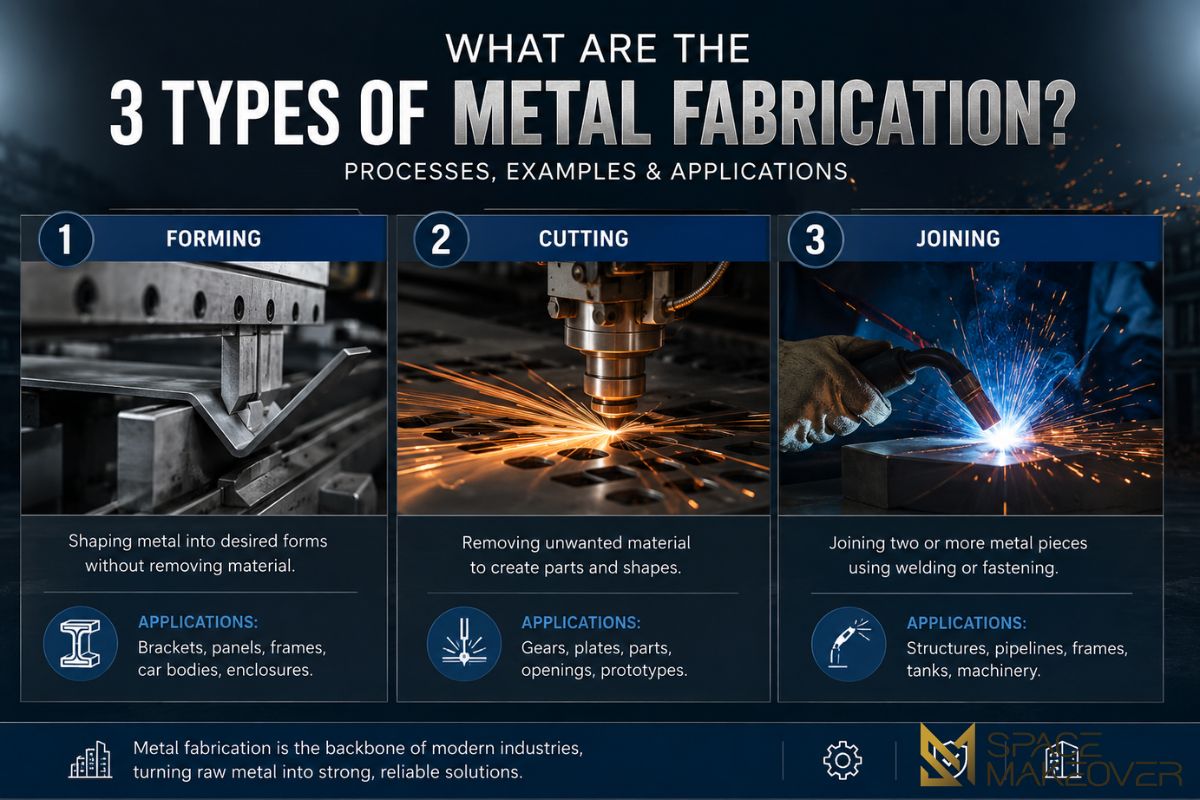
Cutting comes first on almost every job. It’s the removal of material to get a specific shape or size, done with laser cutters, plasma cutters, waterjets, or mechanical shears.
Laser cutting is the best option for precise jobs. The laser is ideal for thin to medium thickness material and allows for tolerance levels that matter. Plasma cutting allows for thicker metal cutting at a much faster speed, but the edge produced will be rough compared to laser-cut parts. Waterjet cutting is chosen when it is important not to distort the material because of the heat produced by plasma cutting and laser cutting.
Common cutting applications:
- Decorative screens and perforated panels
- Structural steel plates, cut before welding
- Signage lettering and logos
- Custom brackets and mounting plates
For metal fabrication work in Dubai, the choice of cutting method usually comes down to thickness, finish, and tolerance. Laser cutting a 20mm plate is technically possible, but slower and pricier than plasma. There’s no single “best” method here. It depends on the job in front of you.
Type 2: Forming and bending
Forming reshapes metal without cutting anything away. A press brake, roller, or stamp applies force to bend, curve, or fold the material into a new shape.
Press brake bending shows up constantly in architectural and industrial work: flat sheet in, precise angled fold out. Roll forming handles continuous curves, like columns or curved facade panels. Stamping is more of a high-volume tool, used when the same shape needs to repeat over and over.
Common forming applications:
- Curved facade cladding
- Enclosures and equipment housings
- Structural angles and channels
- Furniture frames with rounded edges
However, one thing that trips people up: metal springs back slightly after bending. It relaxes a few degrees from the exact angle it was bent to. Good fabricators over-bend on purpose to compensate. It’s a small detail, but skip it, and the part comes out wrong.
Type 3: Welding and assembly
Welding fuses two or more pieces of metal into one structure, usually with heat. This is the stage where cut and formed pieces stop being separate parts and become a product.
MIG welding is the workhorse: fast, reliable on steel and aluminum. TIG produces a cleaner, more controlled weld, so it gets used where the joint is visible, or the material is thin. Spot welding shows up in sheet metal assemblies that don’t need a full seam.
Common welding applications:
- Structural steel frames
- Staircases and railings
- Metal furniture and fixtures
- Gates, doors, and security grilles
Assembly often follows welding: bolting, riveting, or fitting pieces together where a permanent weld doesn’t make sense, like parts that need to come apart later for maintenance.
Comparing the three processes
Where each process is used?
The different manufacturing processes are used by different industries. For example, businesses involved in metal fabrication in Dubai for construction work will mostly use cutting and welding during the process of making, for example, beams, staircases, and railings. Interior design and retail fit-out projects involve more cutting and forming processes to produce panels, custom-made furniture, and displays.
Additionally, some companies involved in metal fabrication Dubai perform all the processes in-house. This allows for consistency in tolerances and measurements used throughout the process. The errors made during each of the manufacturing stages would add up and lead to troubles during the final assembly.
Common mistakes to avoid
- Choosing a cutting method on price alone- The cheapest cut isn’t always the right finish for what you’re building.
- Ignoring spring-back in bending- The part ends up off from the design angle.
- Welding before dimensions are locked- Heat can warp thin material if the sequence isn’t planned.
- Mixing incompatible metals- Weld dissimilar metals without the right filler, and the joint weakens over time.
- Skipping the finish plan- Cut edges, bend marks, and weld seams each need different post-processing. Forget this step, and it shows up later as visible flaws.
Expert insights
The biggest factor in project quality usually isn’t which process gets used. It’s the order things happen in. Cut first without thinking ahead to how a piece will later bend or weld, and you end up re-measuring halfway through the job. Fabricators who plan the full sequence before touching the material, from raw stock to final assembly, tend to land tighter tolerances with fewer reworks.
Thickness changes more than people expect, too. A 1mm sheet and a 10mm plate aren’t the same process at different sizes. They often need different cutting tools, different bending force, and a different welding approach altogether. Metal fabrication companies in Dubai will be helpful.
Wrapping it up
Whether you’re working on a small decorative panel or a large structural frame, cutting, forming, and welding are the heart of many fabrication projects. It’s simple to understand a quote, catch a shortcut, and simply follow what is actually going on with a job once you know what each of these is and where they overlap. Space Makeover can cut, form, and weld one metal element across design to install, if you prefer one team to do it all!
Frequently asked questions
Cutting, forming, welding/assembly. Raw stock is cut into shapes, bent or curved to create the desired form, and welded together to create a complete structure.
Typically, the first operation is cutting. It defines the shape and size of the material from which it is made without forming or welding.
Neither wins outright. Laser suits reduce the thickness of material and detail. Plasma can be used to cut thicker plates at a higher rate of speed and produce a rougher edge.
That’s spring-back. When metal bends, it lets out the tension, so fabricators overbend for the purpose of making up for that recoil.
MIG is faster and good for general steel work. TIG is slower, but provides a cleaner, more precise weld on visible or thin joints.
Yes, and better, typically. If all three stages go with one team, then measurements remain consistent throughout the entire job.
Fabrication is heavily used in the construction of structures and for the creation of decorative components, interior fit-out, signage, automotive services, and furniture making.
Seek a team that does all the cutting, forming, and welding within the facility, provides a clear finishing path, and has experience with your thickness of material.
Yes. Thicker metal plates require different cutting tools, a greater amount of forming force, and a different welding technique than thin sheet metal of the same shape.
Heat from welding can distort thin material if not finalized first or not planned for in the welding sequence to control heat build-up.