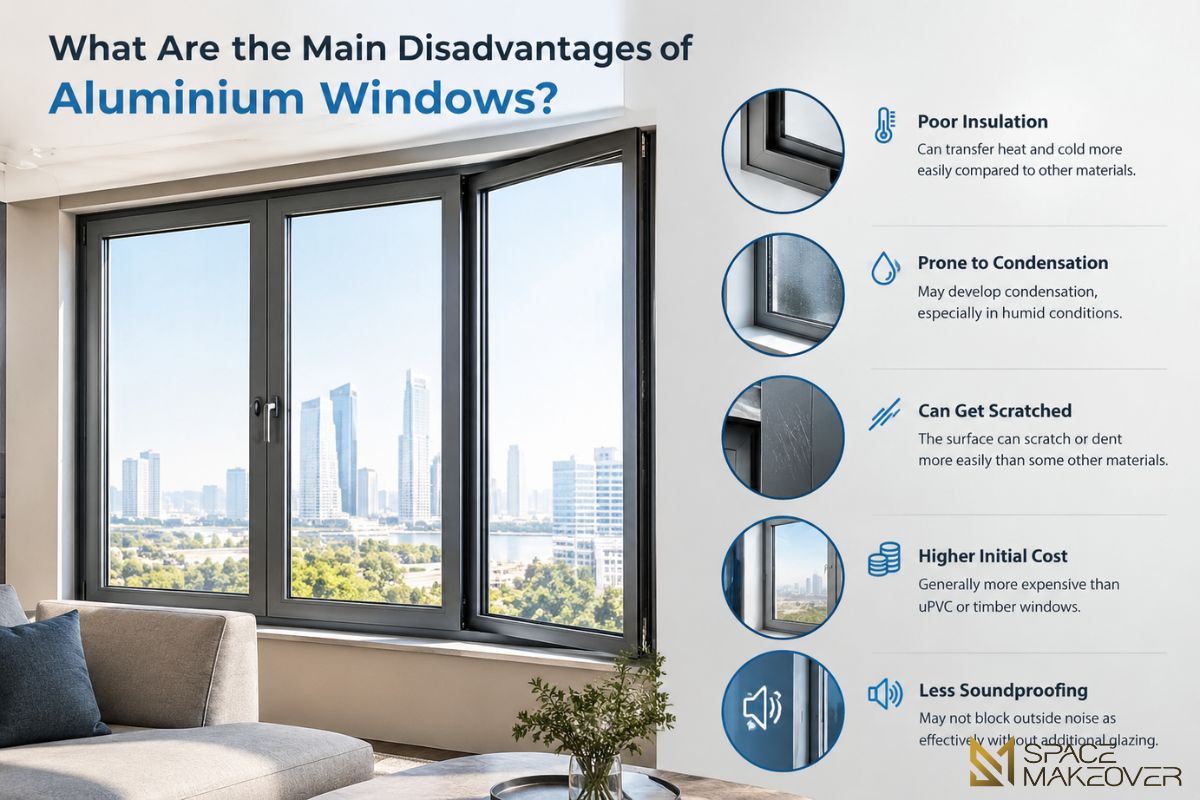
What Are the Main Disadvantages of Aluminium Windows?
Aluminium windows have several disadvantages, including: conductivity of the material – the conductivity of aluminum is around 1000 times higher than that of wood-plastic profiles; cost – aluminium windows will cost you more for the installation than PVC windows; finally, older and not well-sealed frames corrode when they are exposed to coastal air. The thermal conductivity of pure metal is about 160 W/m·K while the thermal conductivity of PVC is 0.17 W/m·K.
Therefore, unless it is treated in a flame-retardant way, it will be very hot by the morning in summer in Dubai due to the high thermal conductivity of metals. Thermally broken profiles reduce the thermal conductivity of materials to 1.2-1.6 W/m²·K, but this solution is quite expensive.
Key takeaways
- Aluminum has a heat conductivity close to 1,000 times that of uPVC, which will have an impact on overall comfort indoors.
- Thermal breaks function to keep the frame cool enough in Dubai’s hot summers.
- Even though aluminum sliding windows in Dubai are more expensive, their lifespan is around 15 to 20 years.
- Good coatings and gaskets help protect aluminum windows from corrosion due to nearby coastal areas.
Aluminium conducts heat fast in Dubai’s climate
Aluminum has a thermal conductivity of about 160 W/m·K, while uPVC has a thermal conductivity of roughly 0.17 W/m·K. This means that aluminum can conduct heat about 1000 times faster, which is an abstract number until you are actually in a room where the temperature outside has stayed above 45°C for the last three weeks, and the frame of the window is acting as a radiator in reverse.
Older windows that have no thermal breaks can have U-values of as high as 5.0 W/m²K. Touch one of these windows in August, and you will instantly understand why condensate collects where the metal of the structure meets the air in the room. Thermal breaks consist of a polyamide strip separating the two aluminum skins of the window and will bring this number to 1.2-1.6 W/m²K, thus making it comparable to the uPVC values; however, the manufacturing process of thermal breaks naturally costs more.
The upfront cost is higher than most people expect
When it comes to installing materials, the cost of aluminum, however, is higher than that of uPVC due to raw material costs, manufacturing costs, as well as the fact that the process of creating a thermal break is also expensive. When the calculations are applied to the whole villa with several openings, the difference between the costs gets larger than just a trivial one.
At this point, it’s not unusual if the owners abandon aluminum installations altogether. Those who choose to go for aluminum will have an interesting conversation ahead of them with a contractor dealing with aluminium doors and windows services in dubai about the cost items. Indeed, a lower price for aluminum may play a trick, as it may indicate that the thermal break isn’t included in the design.
Condensation and corrosion near the coast
The salt air is not very forgiving to metal, but aluminum is able to withstand the atmosphere better than steel. The framing along the Jumeirah coast or the marina strip will wear away much faster if the powder coating is not marine-grade. The process is gradual. It usually goes unnoticed for 5 or 6 years before someone realizes that the finish has started to become uneven.
Furthermore, the condensation issue is different, but related. When humidity meets a frame that is still hot, it creates moisture at the point where the frame meets the glass. The structural implications are usually not a big deal, but neglect over the course of many years can result in a stain on the sill and the development of mould in the corners that have not been cleaned.
Slim sliding windows: why profile choice matters
Most of what’s wrong with older aluminium gets better, not worse, with the newer slim-profile systems. I’ve seen slim sliding windows Ajman installations hold up well over the past few years precisely because they combine a thinner sightline, larger glass area, and a thermal break packed into a frame narrower than anything from the 1990s.
The trade-off is installation tolerance. A slim frame leaves less room for a sloppy gasket seal, so a poorly fitted slim sliding window shows air leaks faster than a bulkier, older-style frame would forgive. The product genuinely improved. The margin for an installer to get it wrong just shrank at the same time.
Where are aluminium sliding windows still in demand?
For all that, aluminium sliding windows in Dubai are still the default in most mid- and high-rise apartments and villas, and there’s a reasonable case for that. uPVC softens and warps under 15 to 20 years of sustained UV and heat in a way aluminium just doesn’t. Aluminium also carries larger glass spans without sagging, which is exactly what floor-to-ceiling glazing needs, and that look is everywhere in newer Dubai builds right now.
So the material isn’t wrong for this climate. It goes wrong when someone specs it badly, strips out the thermal break to shave the quote, or treats the sealing gasket as an afterthought.
Common mistakes homeowners make
- Picking a frame off color and finish samples without asking about U-value or thermal break at all.
- Assuming aluminium is aluminium and comparing quotes purely on price per square meter.
- Skipping the gasket and sealant spec, which is where most long-term leaks actually start.
- Using standard powder coating instead of marine-grade on a coastal-facing elevation.
- Blaming the frame for heat gain that’s coming through cheap or uncoated glass instead.
Expert insight
Almost none of the disadvantages here come from the material itself. They come from cutting corners on the spec. Solid aluminum works in Dubai; address the heat transfer problem with a certified thermal break, not a decorative one; pair it with double-glazed or low-E glass; and use marine-grade coating on anything facing the sea.
I’d narrow it down to three things that separate a frame that lasts from one that doesn’t: a certified thermal break, a gasket rated for repeated heat cycling, and glass matched to the orientation of that specific opening rather than one spec applied to a whole building. Cut any one of those and the real-world performance quietly falls short of whatever the brochure promised.
Aluminium vs uPVC vs timber: A quick comparison
| Factor | Aluminium (thermally broken) | uPVC | Timber |
| Thermal conductivity | ~160 W/m·K (raw), U-value 1.2–1.6 W/m²K with break | ~0.17 W/m·K, U-value 1.4–1.8 W/m²K | Low conductivity, good natural insulator |
| Upfront cost | Higher | Lower | Highest (with maintenance) |
| Lifespan | 35–45 years | 20–30 years | 25–35 years with upkeep |
| Coastal durability | Good with marine coating | Excellent, doesn’t corrode | Poor without regular treatment |
| Max glass span | Large, minimal sagging | Limited on very large panes | Moderate |
| Maintenance | Low | Very low | High |
Final thoughts
Aluminium windows aren’t the miracle material some sales pitches make them out to be, but they’re not the liability critics sometimes claim either. They conduct heat fast, cost more to get right, and need decent coating near the sea. What decides which side of that line you land on is the spec: a real thermal break, matched glass, coating suited to the site. Get those right and most of what’s on this list stops being a problem you actually notice.
If you’re weighing frame options for a villa or apartment renovation, Space Makeover can walk through the thermal break and glazing specs for your specific elevation before you commit to a quote.
Frequently asked questions
Yes, as aluminium conducts heat rapidly, frames that are not treated or not broken thermally. A thermally broken frame will maintain a much closer temperature to room temperature even on the hottest summer day.
Typically, at about 20 to 40% more. It is due to the process of thermal break and cost of materials, but aluminium lasts a long, long time more than uPVC.
Marine-grade powder coating is possible for 30-40 years. Without that coating, corrosion may begin after 5-8 years in salty air.
When humidity encounters a passing frame, and the temperature is transmitted through the frame, predominantly at the glass-frame border. This is greatly reduced by a better thermal break and a correctly sealed glazing unit.
Yes, if the gasket and thermal break are installed properly. Slim profiles only require more accurate fitting to remain leak-free from the older bulkier designs.
Aluminium is used extensively in villas with large window glazings as it can support them better without sagging due to their weight.
Sometimes. The main heat transfer issue with a non-thermal frame can’t be addressed with re-gasketing and replacement of the glazing unit.
Just ask about thermal break certification, the glazing U-value, and whether the coating has been tested for coastal or high u v exposure, not what colors are available.
The colour of powder-coated finishes lasts for 15-20 years. Anodized will become a little dull over time with constant direct sun.
Yes, for most mid- and high-rise units, if the profile is designed with a real thermal break and the glass is selected for the amount of sun that the unit receives.