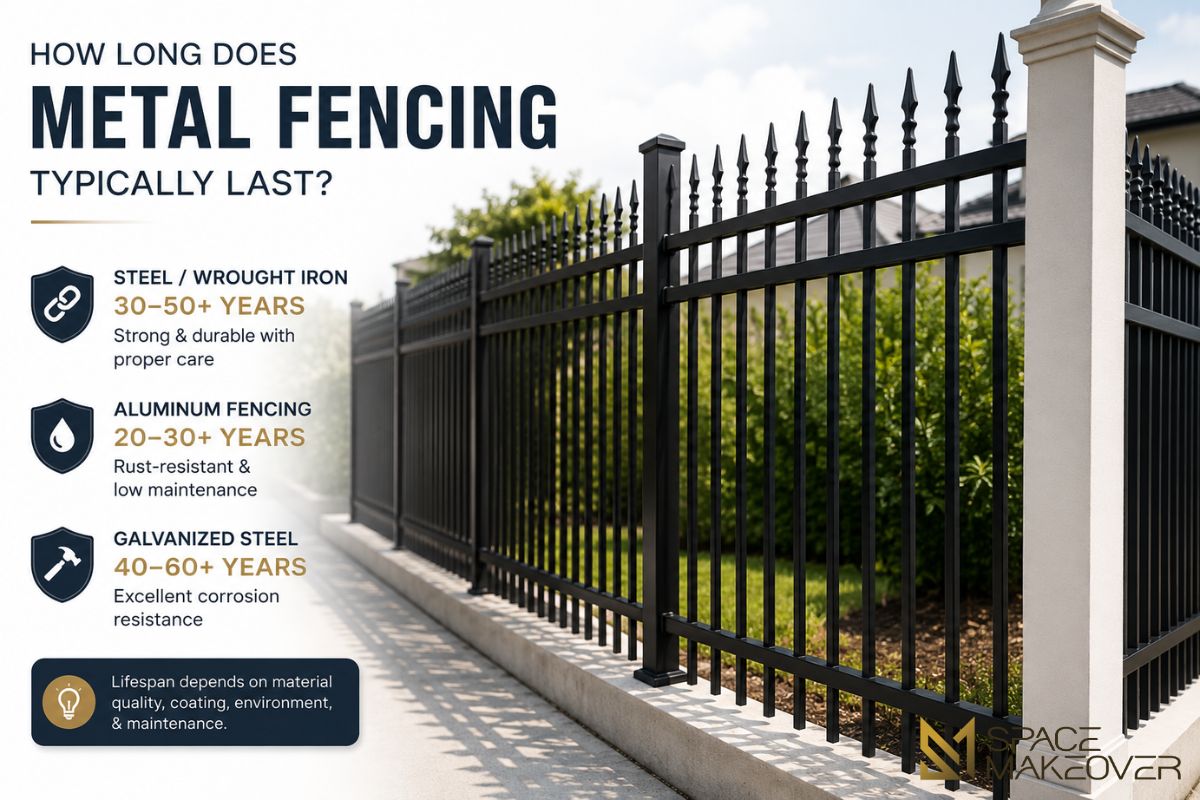
How Long Does Metal Fencing Typically Last?
Metal fencing can last anywhere from 15 years to 50 years or longer, depending on the type of material and how it’s treated. The American Galvanizers Association recognizes hot-dip galvanized steel, as long as it is properly coated, to be capable of preventing corrosion from average climate conditions for more than 50 years. Nevertheless, this number significantly drops in humid, tropical areas like the UAE, where the corrosive effect of salt air has accelerated corrosion.
Aluminum fencing is usually better than steel fencing in this situation since the former does not rust and can last for up to 25-40 years with little maintenance. Wrought iron looks good but requires repainting every 3-5 years to prevent rusting. If you want to compare different types of metal fence, the finishing process and installation quality are even more important than the raw material
Key takeaways
- In Dubai, galvanized steel fencing typically has a lifespan of around 20-30 years with adequate upkeep.
- Aluminum is more resistant to corrosion, making it more suitable for buildings located near the coast.
- Powder coatings protect the structure from damage and allow for an extension of the rooftop structure’s life by 5-10 years.
- Bad installation does more damage to fencing than the selection of the metal.
What determines how long metal fencing lasts?
Three things are more important than anything else in determining the final result: firstly, the metal from which the product is made, secondly, the system of surface treatment, and thirdly, the methodology of installation of the fence. A high-quality steel fence poorly installed will be more likely to fail compared to an average-quality aluminum fence installed properly. It is illogical if only the properties of the material.
However, the first factor, that is the metal, determines the limit of the result. The surface treatment, including galvanizing, powder coating, and anodizing, defines how high this limit is. As for the installation, taking into consideration such aspects as depth of installation, drainage system installed around the base of the fence, quality of welding, and so on, it defines whether one will manage to achieve its maximum efficiency.
If you want any metal fencing services in Dubai, do not forget to ask the contractor about all three important aspects.
Lifespan by metal type
| Metal Type | Typical Lifespan (UAE Conditions) | Maintenance Needs | Best For |
| Galvanized Steel | 20-30 years | Recoat every 8-10 years | Boundary walls, security fencing |
| Aluminum | 25-40 years | Occasional rinse, minimal repainting | Villas, pool areas, coastal properties |
| Wrought Iron | 10-15 years without upkeep, longer with it | Repaint every 3-5 years | Decorative gates, entrances |
| Stainless Steel | 30-50 years | Very low | High-end architectural fencing |
Moreover, these are working estimates based on standard corrosion behavior in Gulf coastal conditions, not lab numbers from a controlled European climate. Salt air, dust abrasion, and UV exposure all shave years off manufacturer-quoted lifespans, which are almost always calculated for temperate environments.
Why does Dubai’s climate change math?
The life expectancy that manufacturers assign to fencing materials is determined under test conditions that are not similar to those of a summer in the Gulf region. There are three things that primarily affect fencing materials.
- Salt corrosion – Materials close to the sea suffer from much more corrosion than those far from it, and fences may rust within just 2-3 years of being installed.
- UV degradation – Because of the high UV radiation, paints and powder coatings deteriorate faster and coatings that would last 10 years in Europe, for instance, will last only 6-7 years in an Arab country.
- Sand and dust abrasion – Fine dust acts like sandpaper and damages coated surfaces during shamal winds, with the most vulnerable point being joints.
For these reasons, a fence purchased from fencing suppliers in Ajman and Dubai needs to be recommended on a climate basis, not by using general specifications typical of countries abroad.
A practical example
A villa in Jumeirah installed galvanized steel fencing rated for 25 years by the manufacturer. Within four years, visible rust had started at the base of every post. Not because the steel was defective, but because the installer skipped a concrete collar around the post base, leaving standing water after every rain and irrigation cycle. The metal was fine. The installation wasn’t.
Signs your fencing is wearing out faster than it should
- Rust blooming at weld points or post bases, usually the first failure point
- Paint or powder coat flaking in sheets rather than fading evenly
- Gates that have started sagging or dragging, often a sign of post movement rather than just hinge wear
- Chalky white residue on aluminum (oxidation, usually cosmetic but worth monitoring)
None of these mean immediate replacement. Most are fixable with recoating or localized repair if caught early.
Common mistakes that shorten fencing life
- Skipping proper drainage at post bases is the single biggest cause of premature failure in this region, more damaging than salt air on its own.
- Choosing the cheapest fastener grade is another one. Fencing panels can be rated for decades while the screws holding them together corrode within a couple of years, and the panels start to loosen and rattle.
- Ignoring recoat schedules matters too. A powder coat isn’t permanent. Treat it as a one-time expense instead of a maintenance item, and a fence that should last 30 years starts looking rough by year 10.
- Buying on price per meter alone is the most common mistake. The lowest quote often reflects thinner gauge metal or a cheaper coating process, not a better deal. Ask what gauge steel or coating thickness is quoted before comparing prices across metal fencing suppliers in Dubai.
Expert insights on getting more years out of your fence
Ask for the coating thickness in microns, not just the coating type. A powder coat under 60 microns wears through noticeably faster in this climate.
Request a concrete collar or base treatment for every post, regardless of what the base package includes.
Rinse fencing with fresh water every few weeks if you’re near the coast. It sounds minor, but it meaningfully slows salt buildup.
Get recoating written into your maintenance plan up front instead of waiting for visible rust to negotiate it later.
Reliable Metal Fencing Services in Dubai should offer this kind of guidance without being asked, since it directly affects how long their work holds up and how often you’ll be calling them back.
Wrapping it up
The lifespan of metal fencing is not something you can search online and blindly assume. It varies based on the grade of metals, coating condition, and the meticulous installation of the fence to meet the specific local requirements. The longest (theoretical) life spans come with galvanized and stainless steel; the finest balance of low-maintenance and coastal properties is achieved with aluminum; and wrought iron provides the aesthetic appeal with the most demanding maintenance.
Space Makeover can guide you through the material options that fit your project and budget specifically according to your property’s exposure.
Frequently asked questions
20-30 years, with periodic recoating, is relatively short compared to 50+ years of salt air and UV when quoted for a temperate climate.
Generally yes. Aluminum doesn’t rust and requires less maintenance, making it a good option for coastal or humid regions.
Every 8-10 years in steel, but in practice 6-7 years if exposed to high UV or coastal.
The primary cause is standing water due to inadequate drainage around post bases, which is a greater cause of damage than general air exposure.
Yes. Compared to galvanized materials, wrought iron should be repainted at least once every 3-5 years to prevent rust pitting.
Don’t ask for price per meter, but obtain information about metal gauge, coating thickness (microns), and the post installation procedure.
Yes, typically if it’s limited to joints or bases. The necessary replacement is typically only required for structural weakening.
The darker coatings are going to absorb more of the UV and heat, which in the long run may accelerate coating breakdown a little bit.
For the majority of villas, no. Suitable for high-end projects where its 30-50 year life is adequate for the price.
Try to find suppliers that offer a quotation stating the thickness of coating and installation techniques, not just the price.