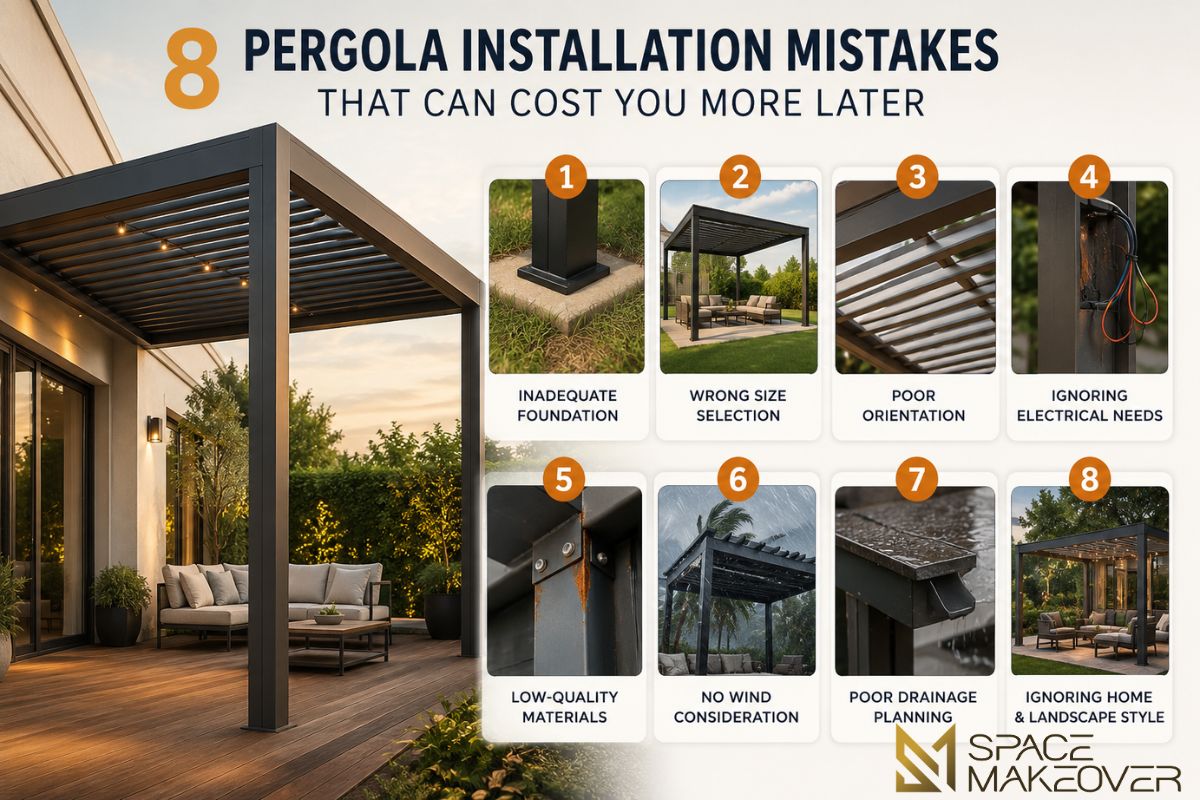
8 Pergola Installation Mistakes That Can Cost You More Later
Key Takeaways
- Proper pergola planning eliminates costly repairs and maintenance issues in years to come.
- Choosing the right materials guarantees that pergolas can survive Dubai’s harsh weather and temperatures.
- Reputable pergola suppliers are able to pinpoint design problems before they lead to expensive errors in construction.
- Permits, drainage, and wind control help avoid serious structural problems and unexpected repair bills.
A pergola looks simple. Some posts, a frame, maybe a motorised roof, and your outdoor space suddenly feels finished. But there’s a real gap between a pergola that’s still solid in fifteen years and one that’s warped, leaking, or flagged by building management within two, and that gap is almost always decided before installation even starts.
We’ve walked into more than a few gardens and terraces at Space Makeover where an earlier installation had gone wrong. Not because the structure itself was badly built, necessarily, but because something before that got missed. Wrong material for the climate. No real drainage plan. A motor that was never meant to sit outside in Gulf humidity. None of this is rare. It happens often enough that it seemed worth putting down on paper.
Below are eight mistakes we run into again and again, plus what to actually check before signing off on a design. Whether you’re still comparing pergola suppliers in Dubai or already partway through a build, this should help you catch problems while they’re still cheap to fix.
1. Skipping proper site assessment
It’s tempting to go straight to the fun part – aluminium or wood, fixed or motorised, white or anthracite grey. However, the considerations don’t matter if the site hasn’t been properly visited yet.
A proper site visit looks at ground condition, how the sun moves across the space during the day, proximity to walls and other structures, and existing water drainage. If this isn’t carried out properly, it can lead to problems such as shadows in the wrong place, or the frame being placed on ground that shifts during summer in Dubai and misaligns the structure.
What to do instead: have whoever you’re working with walk the site before they quote a final price. A fixed quote given over the phone, sight unseen, usually means site-specific issues aren’t being factored in at all.
2. Choosing the wrong material for Dubai’s climate
This is probably the costliest mistake here, mainly because it doesn’t show up right away. It shows up in year two or three, once the warranty’s expired and the sun and salt air have had time to work.
Untreated timber can crack, warp, or fade within eighteen months of Dubai sun if it wasn’t kiln-dried and sealed properly for the region- it looks great in the showroom, which is exactly the problem. On the other side, cheap aluminium extrusions with thin walls tend to bow under their own weight once a motorised louvre system gets added on top.
However, aluminium pergola manufacturers in Dubai who know what they’re doing use powder-coated aluminium with wall thickness suited to local wind and heat, not generic profiles never tested for the region. If timber’s the look you want, wooden pergola suppliers in Dubai worth trusting will steer you toward teak or thermally modified wood, treated specifically for UV and humidity.
| Material | Best For | Watch Out For |
| Powder-coated aluminium | Low maintenance, motorised systems | Cheap extrusions with thin walls |
| Treated/thermally modified wood | Natural look, warmth | Untreated timber not rated for Gulf climate |
| Hybrid aluminium-wood | Balance of durability and look | Poor joinery between materials |
3. Ignoring wind and load calculations
Dubai doesn’t get hurricanes, but shamal winds can hit hard and fast. A frame that wasn’t engineered with wind load in mind can shift, work loose at the joints, or in bad cases, partially come down.
This matters even more with motorised roofs. A retractable louvre system adds weight and catches wind differently than a fixed frame does, so both the motor housing and the frame under it need to be rated for that extra stress.
Additionally, ask for the wind load rating of the frame, and if it’s motorised, the rating in both the open and closed position. If a supplier can’t give you a straight answer, take that as information.
4. Ordering the wrong size for your space
This goes wrong in two directions. Either the pergola’s too small and doesn’t shade the seating area it was meant for, or it’s oversized and swallows a smaller terrace whole, leaving no real walking room.
Fixing it isn’t complicated- it just takes measuring before you order rather than after. Lay out your furniture first, including space to actually move around it, then size the structure to that. A decent rule of thumb: 60 to 90 cm of clearance beyond the furniture footprint on each side.
5. Overlooking permits and building codes
Depending on your building, community, or emirate, a permanent outdoor structure might need sign-off before you install it at all. Villa communities with strict architectural rules and shared compounds are usually where this bites hardest.
Skip this step, and you’re not just risking a fine- you might be asked to remove something you already paid to build, which costs far more than the delay of getting approval up front would have.
Worth checking:
- Whether your community has architectural guidelines covering outdoor structures
- Whether your pergola counts as permanent or temporary under local classification
- Whether motorised or electrical components need separate approval
A supplier with any real experience in Dubai will usually raise this during the consultation, not leave you to find out the hard way afterward
6. Cheaping out on motorisation components
Motorised pergolas are worth it for a lot of households, especially if you’re outside year-round and want the flexibility of adjustable louvres. But this is also where cutting corners causes the most regret later.
Cheaper motors often aren’t rated for outdoor humidity or dust – both of which Dubai has in abundance. A year or two in, people start reporting jammed louvres, motors straining under load, remote systems that just stop syncing.
Moreover, motorised pergola manufacturers in Dubai worth their reputation use motors with proper outdoor IP ratings, plus rain and wind sensors that close the roof automatically before bad weather hits. That last feature sounds minor until the first time it saves your furniture from a surprise downpour.
Ask for the motor’s IP rating, and whether automatic wind and rain sensors come standard rather than as a pricey extra.
7. Poor drainage planning
Water management gets overlooked constantly, and it’s also one of the more damaging mistakes when it goes wrong. Every pergola roof sends rainwater somewhere. If nobody’s planned where that “somewhere” is, water pools near the base, seeps into flooring, or pushes against the foundation posts over time.
When we talk about motorised louvres, this becomes even more important because they require internal drainage systems integrated into the structure to lead the water out properly.
You should go ahead and ask your installer where the water will leave the roof and if there are any drainage systems built for this or if rainwater will simply be left to rely on gravity to arrive on the ground level.
8. Hiring unverified installers
Probably the most avoidable mistake on this list. A pergola can be engineered perfectly and still fail if whoever puts it up rushes the job or doesn’t have real experience anchoring it structurally.
Loose post anchoring, uneven leveling, badly sealed joints between panels — none of this is about the product; it’s about the install. And it’s usually invisible on day one. The pergola looks fine when it goes up. Problems tend to show up months later.
What to look for:
- Photos or references from completed local jobs, not just renders
- Whether the same team handles structural and electrical work, or whether electrical gets subcontracted out
- Whether warranty support is actually available locally, not just through a manufacturer overseas
At Space Makeover, the same team handles design and on-site installation, which is part of why we keep coming back to this point. When one team owns both stages, there’s a lot less room for something to fall through the cracks between them.
Expert recommendation
If you’re comparing pergola suppliers in Dubai, ask each one the same questions: do they visit the site before quoting, where do their materials come from and are they suited to this climate, what’s the wind load rating, how’s drainage handled, and what’s covered under warranty — structure and motor both. The suppliers who answer specifically, rather than falling back on general marketing lines, are the ones worth trusting with something this permanent.
Final thoughts
None of these eight mistakes look dramatic on their own. A slightly wrong material call. A permit check that got skipped. A drainage detail nobody thought through. But add them up and they explain most of the pergola problems people end up dealing with a year or two after installation — right around the point when fixing it costs a lot more than getting it right the first time would have.
The good part is all eight are avoidable, as long as the right questions get asked before anything goes up.
If you’re planning a pergola and want it engineered properly for Dubai’s climate from the start, Space Makeover handles design, materials, and installation as one connected process — a site assessment, a straightforward quote, no generic renders, no guesswork.
Frequently asked questions
A properly engineered aluminium pergola can last 15 to 20 years with minimal upkeep. Wood, if treated and maintained, usually holds up 8 to 12 years before it needs major refurbishment.
Aluminium tends to handle the heat and humidity better and needs less upkeep. Wood looks warmer but requires more maintenance and periodic resealing.
Depends on your community and whether the structure counts as permanent. Villa communities and shared buildings often require approval, so check with management first.
More upfront, because of the motor, sensors, and controls – but a lot of homeowners find the flexibility worth it long term.
Yes, if it’s engineered with the right wind load rating for the region. That’s exactly why checking the rating with your supplier matters more than most people assume.
Most aren’t engineered for local wind, heat, or drainage conditions, so structural or material failures tend to show up within the first year or two.
Ask for references from real local jobs, confirm they handle structural and electrical work directly, and check that warranty support exists locally.
A little, yes. Clean the tracks and sensors periodically, get the motor checked once a year, and most systems keep running fine for years.
Measure your furniture layout first, then add 60 to 90 cm of clearance on each side- size to the furniture, not the terrace.
Sometimes, depending on whether the frame can take the added weight. Worth having a supplier assess it rather than guessing.