Aluminium vs UPVC Windows: Which Blocks Noise Better?
In most Dubai homes, the glass determines how effective a window is at blocking noise, while the frame and seals determine how well that potential is realised. A properly made UPVC window with ordinary glass is more effective at blocking sound than a simple aluminum window, while a thermally broken aluminum system with laminated or thicker double glazing and good seals can be just as efficient, or even better.
If quietness is among your top priorities, it is necessary to inquire about acoustic rating and sealing specifications, rather than just frame type. This guide tells you about each option’s performance, the gaps, and the ways to select a good system for a noisy city.
Key takeaways
- The thickness of glass, laminated layers, and air space are the most essential factors in determining noise levels, so specify them first.
- UPVC does have a slight frame-based advantage, but a thermal break aluminium system will perform just as well.
- Seals and workmanship will determine whether the rated performance of your window is achieved in your home.
- Because of the climate in Dubai, you should look for a product that will hold its seal for years.
How does sound travel through a window?
There are three ways that sound can get to your home: The glass, the frame, and the spaces between the glass and frame. Each path has a significance that differs from the others, and most people attend only one of them. The three and how they work together will help you determine any quote you receive.
Why does glass matter more than the frame?
The glass has the greatest surface area of any window, and so this is the most significant aspect of a window when it comes to the amount of sound energy it carries. Ordinary float glass is very susceptible to vibrations from passing cars or construction activities. The thicker the glass, the more it blocks low-frequency noise, the deep rumble of trucks and generators that can be heard the farthest.
Laminated Glass is even better. It comes with a plastic layer between two glass panes, which absorbs vibration. The use of two different-thickness panes, known as asymmetric glazing, also works best since the panes vibrate at different frequencies and are able to cancel out more sound. A sealed air or gas gap between the panes provides an added layer of protection.
Where does noise actually leak in?
Ideally, the best glass can be ruined if there are gaps at the sides of the window. Sound will seek the smallest opening it can, and a gap as narrow as a pencil line will allow enough sound to pass through for it to be heard clearly indoors. Typical leak locations are:
- Hardened or worn rubber gaskets around the frame
- Opening spaces between sash and frame on sliding windows
- Inadequate interlocking between the sliding panels.
- Poor seal around window or wall installation.
Moreover, that’s why installation quality and the design of the seal are as important as the material selection.
Main differences between aluminium and UPVC frames
They’re both popular materials in Dubai, and both can be crafted into quiet, durable windows. These vary in hardness, strength, and heat and vibration resistance.
- Material and Structure
Aluminium is a metal, which means that it is strong and stiff. This enables slimmer frames, larger glass panels, and wider sliding openings with a slim profile. Aluminium frames require a thermal break, which is a thin section of insulation within the profile, preventing heat transfer through the metal. The newer thermally broken profiles are far more comfortable and quieter than the solid versions.
UPVC is a hard plastic that is made from polyvinyl chloride. It usually has several compartments inside, which are hollow and provide insulation and some damping. UPVC does not require a thermal break, and the profiles are usually thicker than aluminium.
- Thermal and sound behaviour of each frame
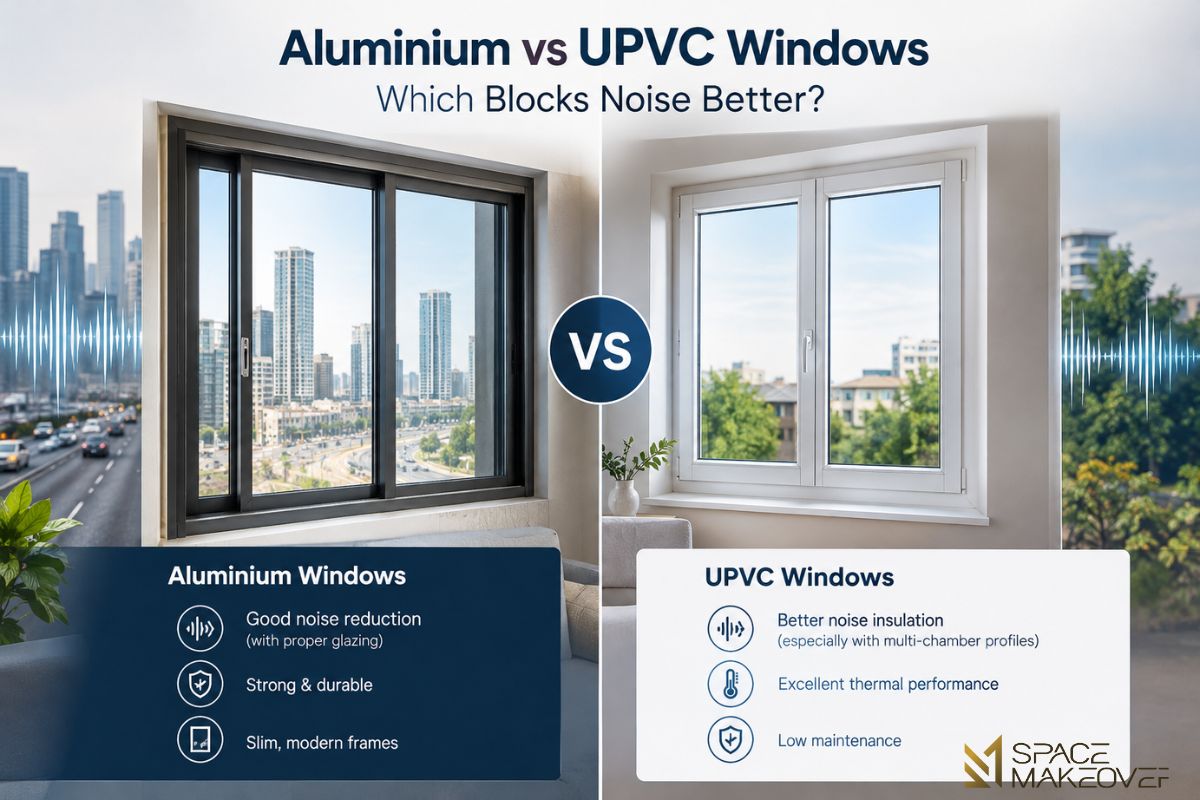
Vibration is easier to conduct in metal than in plastic. This is the primary reason why a basic aluminium frame will conduct more noise than a UPVC frame with the same type of glazing. This effect can be minimized with good aluminium systems, which incorporate thermal breaks, internal insulation and high-density gasketing, but it may still be significant in highly noisy environments.
UPVC is not as stiff as aluminium. This is because over time and under extreme heat, the quality of lower-grade UPVC may slightly warp or sag. A sagging sash creates gaps, and gaps allow noise to enter. There are several reasons to select a reputable manufacturer, one of which is to inspect the profile thickness and reinforcement.
Aluminium vs UPVC for noise: which is better
In order to fairly compare the two, you must have the same glass, the same seals, and the same installation. In such circumstances, the acoustic advantage of UPVC can be very small at the frame level. But the difference between good and bad products in each material is typically greater than the difference between different materials.
Where UPVC usually has the edge
UPVC is generally good in these conditions:
- Residential areas adjacent to major thoroughfares where a typical glazed window is the primary concern.
- If the glass and seals are not going to be intricate, then budget projects will be in order.
- Other openings like bedroom or bathroom windows
- Buildings where a thicker, insulated profile suits the design
Where can Aluminium match or beat UPVC?
Aluminium can provide excellent noise control when designed for it. It tends to be the winner in the following situations:
- Large sliding openings with thinner or laminated glass that will fit through a thin frame
- Projects that have frames which are thermally broken and have multiple points of locking
- Any windows where there is a sliding design and the panels are heavy and substantial.
- Installations where the supplier uses high-grade seals and precise tolerances
Therefore, aluminium frames are able to support more weight of glass and not bend over time, which ensures the seals stay in place over the years. This uniformity is useful for long-term noise control.
Quick comparison table
| Factor | Aluminium Windows | UPVC Windows |
| Frame stiffness | High, supports heavy glass | Moderate, depends on profile |
| Frame sound transmission | Higher unless thermally broken | Generally lower at the frame level |
| Glass capacity | Strong, suits thick or laminated glass | Good, limited by frame size |
| Best for large sliding openings | Yes | Less common |
| Slim sightlines | Yes | Usually bulkier |
| Heat behaviour in Dubai | Stable with thermal break and quality coating | Good, but lower-grade profiles can warp |
| Noise performance depends most on | Glass, seals, and installation | Glass, seals, and installation |
As seen in the table, there is no automatic winner; both materials must contend for victory. The ideal choice of noise will depend on the size of the opening, the glass package, and the quality of the sealing.
Why do Dubai homes need strong noise control?
In Dubai, noise can be found in many places. The noise from the traffic on main roads, construction on the outskirts of expanding residential communities, and the steady background noise from air conditioning systems all combine. Others may be located near the busy commercial areas or service roads where delivery vehicles arrive late at night.
Traffic, construction and airport noise
Low-frequency sounds can travel through standard glass, whereas high-frequency sounds are not as easily transmitted. Construction noise is harsh, irregular and loud noises like drilling or hammering. If you own a house with regular aircraft flight paths or near an airport, there may be aircraft noise as well. It is more important to select glass that has a good sound rating in these areas than in quieter residential streets.
Heat, dust, and wind pressure considerations
Dubai window performance will be influenced by the climate, and the same will impact noise performance. Expansion and contraction of material due to the high daytime temperature can cause seals to loosen over time. Fine desert dust accumulates in tracks and gaskets, and decreases gripping ability. Strong winds exert pressure on large panels and may bend weaker frames. All these need to be met by a quiet window, the frame, hardware and gaskets have to cope with the environment in Dubai as well as traffic.
How to choose a quiet window system?
When you use a specific process, it is easier to select a window for noise. When looking at quotes, follow these steps:
- Determine the source of the noise: Indicate if it is traffic, building works, aircraft or neighbours, and if on the street side or from a shared wall.
- Inquire about the glass type: Ask for the type, thickness, interlayer, and air gap of the glass. Strong double glazing and laminated and asymmetric double glazing are good choices for noisy sites.
- Ask for the acoustical rating: Don’t ask for the sound reduction rating of the window – ask for the sound reduction rating of the entire window. Verify if the figure is for a tested system.
- Examine the structure of the frame: If you’re fitting aluminium, check that its thermal break is in place. In case of UPVC, verify the wall thickness and number of chambers.
- Inspect the seals: Ask for information regarding the window’s gasket type, number of seal lines, and whether the panels in the window are brush or interlock.
- Review installation method: Inquire about the method of securing the window to the wall and the manner in which the opening around the window frame will be closed.
- Ask to see a site visit: A surveyor who measures the opening and records the noise sources can recommend a more accurate system.
Why do aluminium sliding windows work well in Dubai?
A lot of Dubai homes are characterized by wide balconies, extensive living rooms, and openings that reach from floor to ceiling. Aluminium sliding windows are a practical choice for these areas, providing a blend of size, strength and style. They are lightweight, so they allow more light to pass through and provide a clean aesthetic that would complement contemporary decor.
Large openings and slim sightlines
Aluminium sliding windows in Dubai can be used to enclose large windows without a central post, preserving all the views. Noise control doesn’t have to be sacrificed with slim sightlines. A good sliding system is designed to retain laminated or thicker glass and slide securely against the gaskets. By selecting the appropriate specification, homeowners can obtain both open and quiet in their home.
Single fixed panels with one opening sash can provide good sound transmission performance in smaller rooms at lower cost. A reliable supplier will be able to help you determine if a full sliding system or a combination layout will best fit you and your space.
Working with the right supplier
When you look for supplier responses to your technical questions, make sure they are clear, not vague. A good provider will clarify the glass package, the profile system, the seals, and the testing involved behind their claims. They will also describe properties of their windows relating to heat, dust, and wind. Request samples of gasket and hardware and ask for references from past projects that are close to busy streets.
Aluminium and Glass Systems are used in Space Makeover for Dubai houses, and they will be able to tell you what you have the choice of in your particular area. Before requesting a survey, you can visit the Space Makeover website to see the available options.
Aluminium doors and windows services: what to check
The installation of a window product is a key factor in how well the window will perform. While the best product in the world is useless if it is not installed well, the installation service is as important as the product.
Installation quality makes the difference
The first rule of accurate measurement is to measure accurately. The frame should be installed: square, level, and plumb, and should have the appropriate clearances for expansion. The space between the frame and the wall must be filled with the appropriate material and not just foam. The panels should slide freely and smoothly and close evenly along their entire length.
Professional installers also test the equipment following installation. Locks, rollers, and handles must lock properly and keep the sash firmly against the gasket. Even the best window glass will not stop noise from escaping if there is a gap or if the window rattles.
Questions to ask before you book
Before signing with any aluminium doors and windows services in Dubai, seek answers to the following questions:
- What thickness and type of glass should I get for my noise level?
- Does the aluminium profile meet the thermal break requirements?
- How many seal lines are there in the sliding system?
- Is it possible to show test data for the entire window system?
- What is used to fill in the space between the frame and the wall?
- Which warranty applies to the seals, hardware, and glass?
- Who will be doing the installation in the field?
Answers to these questions will demonstrate a supplier who understands sound control, not just the product.
Cost: Are quieter windows worth the price?
The price of noise control increases substantially compared to the price of a basic window, primarily due to the glass. Thicker double glazing is also more costly, and the thermally broken aluminium profile is more expensive than the standard aluminium profile. But it needs to be balanced against the advantages of sleeping well, working from home in comfort and a more relaxed lifestyle.
When you’re making comparisons of quotations, be sure they are based on the same specification. The “cheap” price could be due to thinner glass, less complicated seals, or a shorter warranty period. Request each supplier to specify the glass type, profile, hardware, and installation separately to compare like with like.
Moreover, the noise control changes are most easily accomplished in a staged manner. For instance, you can replace the windows in front of the main road first, then you can replace the bedroom windows later and not replace windows on less exposed sides. This will allow you to invest in the loudest noise.
Common mistakes that reduce noise blocking
There are many common mistakes that a lot of homeowners make that cause them to lose noise performance. Be aware of these:
- Not reading the glass specification to choose the frame material
- Going back to the standard glass on a busy road is not an option.
- Not sealing the wall gap during installation
- Not paying attention to worn gaskets and sticky hardware during routine checks
- Not cleaning sliding tracks, which prevents full closure of panels
- Comparing quotes that list different glass or seal options
Simple maintenance is of great assistance. Every few months, clean tracks and gaskets; lubricate the rollers as directed by the manufacturer, and ensure the sash continues to close easily. Some minor tweaks can help restore a seal and return most of the quietness. Aluminum works in Dubai can be helpful.
Final thoughts
Both UPVC and aluminium can efficiently cut out noise, provided they are chosen and fitted correctly. In most typical situations, UPVC has a small advantage when it comes to frames, but aluminium benefits from added strength, narrow profiles, and large sliding openings suitable for a home in Dubai.
The most important aspects are the type of glass used, the quality of seals, and the expertise of the installer. Look for plenty of technical information; compare systems to ensure you are matching similar products, and choose a supplier who is able to answer your questions about the specifics of the system in your location. A quiet home is well within reach when you approach the decision with the right information.
Frequently asked questions
UPVC usually has an advantage on the hardware side, yet the glass and seals of the window usually hold more importance. A thermal break window made of aluminum frames with laminated glass can be as effective as a UPVC window.
It is advisable to use laminated glass in areas close to busy streets as well as construction sites. Its interlayer muffles vibrations and hence reduces low-frequency noises created by traffic more than ordinary glass can.
A sliding window has more connecting points and seals than a fixed one; therefore, it should be specified more thoroughly. A quality sliding system with multipoint seals can reduce the noise effectively.
Ask your provider for the sound reduction rating of the complete window with its test certificate. Compare this figure with the glass and seal specifications to make sure that the ratings apply to the window you are purchasing.