

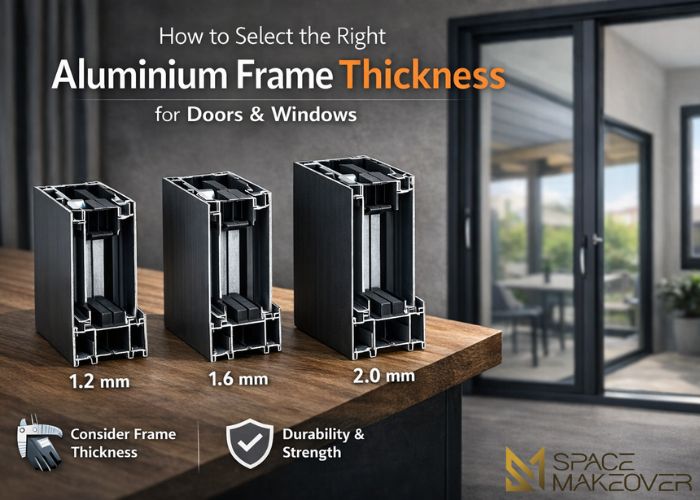
How to Select the Right Aluminium Frame Thickness for Doors & Windows
Table of Contents
- Summary
- Why does aluminium frame thickness matter?
- Understanding aluminium frame thickness
- Factors that decide the right frame thickness
- Choosing thickness for different door and window types
- Climate, wind, and building height considerations
- Safety, security, and long-term performance
- Common mistakes to avoid while selecting frame thickness
- Final checklist before making a decision
- Conclusion
- Frequently Asked Questions
Summary
- Selecting the best aluminum thickness will guarantee that the aluminum frame is strong, safe to use, functions smoothly, and has a durable lifespan.
- Thickness of the frames should depend on the size of the doors, the weight of the glass, the level of use, and the
- Correct thickness selection helps in the avoidance of bending and maintenance, and it is essential for the proper functioning of doors and windows.
The use of aluminum doors and windows is a clever choice for modern buildings. They appear clean and durable and require minimal care. Nevertheless, there is one significant aspect that most individuals do not pay much attention to, and that is frame thickness. In case of improper thickness, doors can shake, windows can bend, or fittings can break in the long run.
Therefore, it is necessary to know how to choose the appropriate thickness of the aluminum frame. Particularly in designing the aluminium doors and windows in Dubai, where the weather conditions and the construction styles require strong and stable systems.
In this blog we will guide you in all that will assist you to make informed decisions.
Why does aluminium frame thickness matter?
The thickness of the frame determines the degree of strength and stability of a door or window. Even though aluminum is light, it requires proper thickness to support everyday use.
A thin frame can be attractive initially. Yet, it is capable of bending when it is pressured, particularly with massive glass panels. Conversely, a frame that is too thick can make it costly and decrease the smooth appearance. Hence, balance is highly essential.
The proper thickness assists in:
- More efficient glass panels.
- Smooth opening and closing
- Better safety and lifespan.
- Extended service with less servicing.
Understanding aluminium frame thickness
Frame thickness means the thickness of the aluminum profile wall. It is measured in millimeters.
In simple words:
- Thicker frames = more strength
- Thinner frames = lighter and sleeker look
Nevertheless, being thick does not necessarily make it better. The appropriate thickness is determined by the use, size, and place. Besides, frame design is also an issue, not only thickness.
Factors that decide the right frame thickness
There are a number of practical considerations that are used to determine the appropriate thickness. Ignoring any of them will lead to issues in the future.
- Size of the opening
The frames of large doors and wide windows should be thicker. Small windows would be suitable with standard thickness.
- Type of glass used
Glass that is laminated or doubled is heavier. So, it should be supported with more frames.
- Usage frequency
The doors that are used frequently during the day need more strength than the fixed windows.
- Design preference
In case you prefer a clean and modern appearance, the frame must be powerful enough despite its thin design.
Besides, quality installation is also important. Even the finest thickness will not work well when fitted incompetently.
Choosing thickness for different door and window types
The various systems have varying thicknesses. Making a hasty choice may cause premature harm.
- Sliding systems
In the case of large sliding panels, strength is important. Such systems as slim sliding doors in Dubai require a well-calculated thickness in order to ensure their strength and beauty. Despite their appearance of being light, the interior frame is required to accommodate heavy glass and even movement.
- Folding systems
In aluminum folding doors in Dubai, the panels fold and move in unison. Therefore, frames have to be able to accommodate continuous movement. The fainter profiles assist in the alignment and smooth running in the long term.
- Casement doors and windows
These are open inwards or outwards and dependent on hinges. The weight should not be stressed on the hinges by the thickness.
- Fixed windows
Their motion is not high, and so moderate thickness is normally sufficient. Nevertheless, the size and weight of glass are still important.
Climate, wind, and building height considerations
Frame performance is highly influenced by the environment.
- Wind pressure
The tall buildings are exposed to high wind forces. Heavy frames eliminate bending and vibration.
- Temperature changes
Aluminum is temperature expanding and contracting. This movement is managed by proper thickness, which does not cause damage.
- Humidity and dust
In dusty and damp cities, heavy frames hold their shape and quality of fitting longer.
However, the choice of the appropriate thickness is not merely a matter of appearance but also the way the building will relate to nature.
Safety, security, and long-term performance
Frame thickness has a direct influence on safety. The locks and hardware may not be firmly attached in thin frames. This can reduce security.
A well-chosen thickness:
- Securely holds locking systems.
- Reduces the possibility of glass breakage.
- Eliminates distortion of frames with time.
Additionally, strong frames lower the maintenance expenses. There are reduced repair and alignment problems and replacement risks.
In planning the aluminum works in Dubai, experts tend to advise on the thickness depending on the use of the building and not only the appearance. This will guarantee value and tranquility in the long run.
Common mistakes to avoid while selecting frame thickness
There are numerous repeat customers who make the same mistakes. It is possible to save money and stress by avoiding them.
- Choosing based only on price
- Choosing slim frames on big openings.
- Ignoring glass weight
- Ignoring building height and exposure to wind.
- Focusing only on appearance
Furthermore, budget is important, but when the thickness is not selected properly, it will cost more in the future.
Final checklist before making a decision
Checklist Before making a final decision, run through the following list:
- Is the opening size big or small?
- What is the type of glass that is going to be installed?
- What will be the frequency of use of the door or window?
- Is it a low-rise or a high-rise building?
- Is the design required to be strong and have a slim appearance?
Additionally, one should never install without discussing technical details.
Conclusion
It is not a difficult task to choose the appropriate thickness of the aluminum frame when practical needs are in mind. The right thickness enhances the strength, safety, and daily performance without affecting the design. It guarantees that your investment will last you years with minimal problems.
Moreover, when planning homes, offices, or commercial areas, careful planning is the key. Aluminum doors and windows and aluminium folding doors in Dubai are durable, comfortable, and modern when selected with wisdom, and this is one of the things that can withstand the test of time.
Frequently Asked Questions
Frame thickness provides strength, stability, easy operation, safety, and durability of doors and windows.
No, the right thickness is based on the door size, weight of glass, use, and conditions of the building.
Yes, wrong thickness can lead to bending, poor fitting, hardware failure, and higher maintenance costs.